
When you pick up a generic pill at the pharmacy, you expect it to work just like the brand-name version. But how does the FDA make sure it actually does-especially after it’s already on the shelf? Unlike brand-name drugs, which go through years of clinical trials before approval, generic drugs are approved based on one key requirement: bioequivalence. That means they must deliver the same amount of active ingredient into your bloodstream at the same rate as the original. But that’s just the start. What happens after the drug hits the market? That’s where post-market surveillance kicks in.
Why Post-Market Surveillance Matters for Generics
Over 90% of prescriptions in the U.S. are filled with generic drugs. That’s more than 3 billion prescriptions a year. These drugs save patients and the healthcare system billions. But because they’re approved without large-scale clinical trials, the FDA can’t know every possible side effect before they’re widely used. Some problems only show up when thousands-or millions-of people take the drug over time.
Take a complex generic inhaler, for example. Two products might have the same active ingredient and meet bioequivalence standards. But if the particle size, delivery mechanism, or inactive ingredients differ slightly, some patients might not get the full dose. That’s not always detectable in a 50-person trial. It might only become clear when a few hundred patients report worsening asthma after switching brands.
This is why the FDA doesn’t stop monitoring once a generic is approved. The real safety picture only emerges after the drug is in real-world use. As former FDA Director Dr. Janet Woodcock said, "The true picture of a product’s safety actually evolves over the months and even years that make up a product’s lifetime in the marketplace."
The Tools the FDA Uses to Watch Generic Drugs
The FDA doesn’t rely on guesswork. It uses a layered system of data collection and analysis to catch problems early. Here are the main tools:
- FDA Adverse Event Reporting System (FAERS): This is the backbone. Doctors, pharmacists, patients, and manufacturers report side effects, allergic reactions, or unexpected outcomes. In 2023, FAERS received over 1.5 million reports-about 40% of them involving generic drugs.
- MedWatch: A public-facing portal where anyone can report a problem with a medication. If a patient feels their generic isn’t working the same way as before, they can file a report here. These reports are flagged and reviewed by FDA scientists.
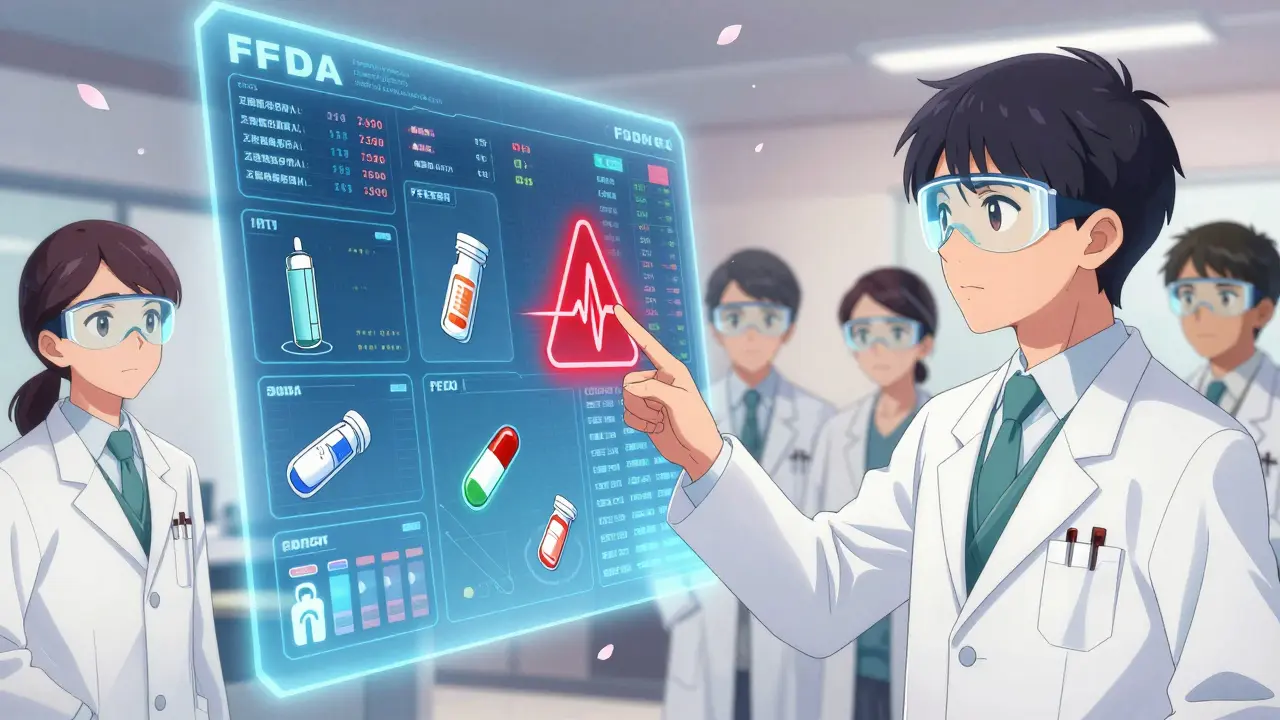
- The Sentinel Initiative: This is the FDA’s most powerful tool. It taps into real-time health data from over 200 million Americans-insurance claims, electronic health records, hospital databases. Instead of waiting for someone to report a problem, Sentinel can spot patterns: Are people on a certain generic version being hospitalized for kidney issues more often than others? It finds signals before they become crises.
- Unannounced Inspections: The FDA doesn’t just watch what happens after the drug is sold. It shows up at manufacturing plants without warning to check if the production process still matches what was approved. One 2022 inspection found a generic manufacturer was using a different excipient (inactive ingredient) than what was on file. The batch was halted before it reached patients.
These systems don’t work in isolation. When FAERS reports spike for a specific generic, Sentinel checks if hospitalization rates for that drug are rising. If so, the FDA’s Office of Generic Drugs (OGD) launches an investigation.
Complex Generics: The Hardest to Monitor
Not all generics are created equal. Simple tablets-like metformin or lisinopril-are easy to replicate. But complex generics? That’s where things get tricky.
Think of inhalers, topical creams, injectables, or extended-release pills. These drugs depend on how the ingredients are structured, not just what’s in them. A slight change in particle size, coating, or solvent can affect how the drug is absorbed. Bioequivalence studies can’t always catch this.
In 2021, the National Academies of Sciences warned that current methods for monitoring complex generics are inadequate. Since then, the FDA has invested $5.2 million in research to build AI-driven tools that can analyze real-world data faster. One project, led by the University of Maryland, is training machine learning models to compare outcomes between brand-name drugs and their generic counterparts using millions of patient records.
Early results are promising. In a pilot study, the AI system flagged a generic version of a topical corticosteroid that was linked to higher rates of skin thinning-something that had been reported anecdotally for months but never confirmed. Within weeks, the FDA issued a safety alert and asked manufacturers to review their formulations.
What Happens When Something Goes Wrong?
When the FDA finds a potential safety issue, it doesn’t wait. Here’s what the process looks like:
- Signal Detection: A pattern emerges in FAERS or Sentinel-say, a spike in reports of low blood pressure with a specific generic version of a blood pressure drug.
- Epidemiological Review: Scientists analyze whether the link is real or just coincidence. They control for age, other medications, and underlying conditions.
- Investigation: The FDA contacts the manufacturer, reviews production logs, and may retest samples.
- Action: Depending on the severity, the FDA can:
- Require a label update to warn of the risk
- Issue a "Dear Healthcare Provider" letter
- Ask the company to voluntarily recall the batch
- Block future shipments until the issue is fixed
In 2023, a generic version of a seizure medication was pulled after multiple reports of breakthrough seizures in patients who had been stable on the brand. The FDA found the tablet dissolved too quickly in the stomach-changing how the drug was absorbed. The manufacturer had changed the binder without notifying the FDA. The fix? A new formulation, retesting, and a full reapproval.
Patient Perceptions and the Nocebo Effect
It’s not always about the drug itself. Sometimes, the problem is in the mind.
Studies show that when patients switch from a brand-name drug to a generic, some report side effects-even when the active ingredient is identical. This is called the "nocebo effect." It’s the opposite of the placebo effect: expecting harm leads to experiencing harm.
A 2019 JAMA Internal Medicine study found that 15% of adverse event reports for generics mentioned "it doesn’t work like the brand," even though lab tests showed no difference. This isn’t just psychological-it can lead to non-adherence. If patients stop taking their meds because they think the generic is weaker, their condition can worsen.
The FDA now trains healthcare providers to talk to patients about this. Pharmacists are encouraged to explain that generics are held to the same standards. And the agency is working with patient advocacy groups to reduce stigma around generics.
What’s Next for Generic Drug Safety?
The future of post-market surveillance is faster, smarter, and more automated.
The FDA is investing heavily in AI and machine learning to predict risks before they become public health issues. By 2027, experts predict AI systems will cut the time to detect safety signals for complex generics by 60-70%. That means fewer patients exposed to risky products.
They’re also expanding Sentinel to include more data sources-like pharmacy dispensing records and wearable health devices. Imagine a system that notices a cluster of patients on a certain generic suddenly showing abnormal heart rhythms on their smartwatches. That kind of real-time insight could save lives.
But challenges remain. Funding is still limited. Some critics argue the FDA doesn’t have enough staff to keep up with the 15,000+ approved generics. And while AI helps, it’s not magic-it still needs human experts to interpret results and make decisions.
What’s clear is this: the FDA’s job doesn’t end when a generic drug gets approved. It’s just beginning. The system may not be perfect, but it’s evolving-and it’s watching.
Are generic drugs as safe as brand-name drugs?
Yes. Generic drugs must meet the same strict standards as brand-name drugs for quality, strength, purity, and performance. The FDA requires them to be bioequivalent-meaning they deliver the same amount of active ingredient into the bloodstream at the same rate. Post-market surveillance ensures they stay safe after approval. While rare issues can arise-especially with complex generics-the system is designed to catch them quickly.
How does the FDA know if a generic drug is causing side effects?
The FDA collects reports from doctors, pharmacists, patients, and manufacturers through systems like FAERS and MedWatch. It also uses the Sentinel Initiative to analyze real-world health data from millions of patients. When a pattern emerges-like more hospitalizations linked to a specific generic-the FDA investigates. It doesn’t rely on single reports; it looks for trends across large datasets to confirm if the drug is truly the cause.
Can I report a problem with a generic drug myself?
Yes. Anyone can report side effects, medication errors, or quality issues through MedWatch, the FDA’s online reporting system. You don’t need to be a doctor. If you notice a change in how you feel after switching to a generic-like new side effects or reduced effectiveness-your report matters. Thousands of patient reports help the FDA spot problems early.
Why do some people say generic drugs don’t work as well?
Sometimes, it’s not the drug-it’s perception. The nocebo effect can make people feel worse after switching to a generic, even if the medicine is identical. Other times, differences in inactive ingredients (like fillers or coatings) can affect how quickly the drug is absorbed, especially in complex formulations like extended-release pills. The FDA investigates these cases to determine if there’s a real biological difference or just a patient experience issue.
What happens if a generic drug is found to be unsafe?
The FDA can take several actions: require updated labeling to warn of risks, issue a safety alert to doctors, request a voluntary recall, or even block the manufacturer from selling the product until the issue is fixed. In extreme cases, the FDA can revoke approval. These actions are rare but effective. Since 2018, over 200 generic drug safety actions have been taken, mostly involving labeling updates or recalls of specific batches.
Jody Fahrenkrug
January 15, 2026 AT 18:16Honestly, I never thought twice about generics until my mom had a bad reaction to a new batch of her blood pressure med. Turned out the filler was different-she got dizzy for a week. Scary stuff. Glad the FDA’s watching, but it shouldn’t take a near-miss for people to realize how much we’re trusting invisible chemistry.
Kasey Summerer
January 17, 2026 AT 12:29So let me get this straight… we’re trusting Big Pharma’s ‘generic’ versions of life-saving drugs… made in India or China… with zero clinical trials… and we’re supposed to be chill about it? 😅
kanchan tiwari
January 18, 2026 AT 22:09THEY’RE LYING TO US. I KNOW IT. The FDA? Controlled by pharma giants. They let the same factories that made tainted heparin and melamine milk in China churn out your ‘generic’ antidepressants. Your thyroid meds? Probably made by a guy in a basement with a blender. I’ve seen the leaks. They’re not testing bioequivalence-they’re testing how fast they can get it out the door. Millions are dying quietly. No one talks about it because they’re too busy scrolling TikTok.
Bobbi-Marie Nova
January 20, 2026 AT 05:07LOL I switched to generic Adderall last year and thought I was going crazy-felt like a zombie. Turned out the new batch had a different dye and I was just psyching myself out. Then I read the nocebo thing and was like… ohhh. Still, I switched back to brand for now. Worth the $100 extra to not feel like a ghost. 🙃
john Mccoskey
January 21, 2026 AT 19:00The entire framework of generic drug approval is a statistical illusion built on the false premise that bioequivalence equates to therapeutic equivalence. The FDA’s reliance on 50-subject trials to extrapolate outcomes across a population of 3 billion prescriptions is not just inadequate-it’s epistemologically bankrupt. You cannot model human physiological variance through pharmacokinetic curves alone. The absence of large-scale longitudinal data prior to market entry creates a systemic blind spot that FAERS and Sentinel can only partially mitigate, and even then, only after harm has already been distributed. The AI models being developed are merely band-aids on a hemorrhage. We are not monitoring safety-we are conducting a nationwide, uncontrolled, retrospective cohort study with no informed consent. The real scandal isn’t the occasional recalled batch-it’s that we’ve normalized this as acceptable risk.
Ryan Hutchison
January 22, 2026 AT 23:36Why are we letting foreign manufacturers make our meds? We don’t outsource our ammo or our nukes. Why the hell are we outsourcing our health? If this was a Chinese-made iPhone glitching, we’d ban it. But a generic pill that might make someone have a seizure? Nah, let’s just ‘monitor’ it. America’s healthcare system is a joke. We need domestic production. End of story.
Stephen Tulloch
January 23, 2026 AT 10:09AI-driven surveillance? Cute. 😎 But let’s be real-this is all just PR theater. The FDA’s budget hasn’t kept up with the 15,000+ generics on the market. They’re running on fumes and goodwill. Meanwhile, Big Pharma is quietly lobbying to weaken bioequivalence thresholds. You think Sentinel’s catching everything? Nah. It’s catching what they *want* you to know. The real story? The ones that slip through are the ones that kill.
Melodie Lesesne
January 24, 2026 AT 16:27Thanks for writing this. I work in pharmacy and see patients panic over generic switches all the time. Most of the time, it’s the nocebo effect-but sometimes, it’s real. The key is communication. If we explain *why* the switch happened and reassure them it’s not a downgrade, adherence goes up. The system’s not perfect, but when it works? It saves lives and money. Let’s keep pushing for better tools, not just fear.