
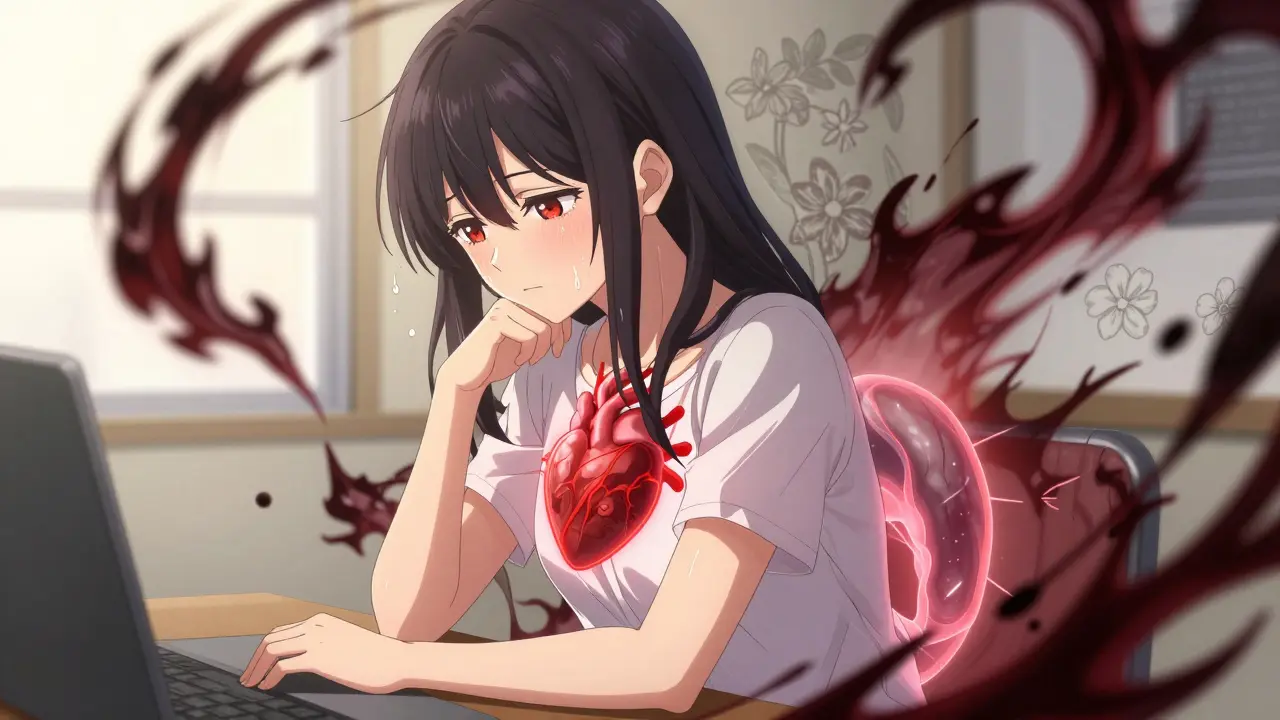
Imagine your body flooding with adrenaline for no reason. Your heart pounds like you’re running from danger, your head throbs, you sweat buckets-and you’re just sitting at your desk. This isn’t anxiety. It’s not a panic attack. It’s something far more dangerous: pheochromocytoma, a rare tumor on your adrenal gland that’s secretly pumping out stress hormones 24/7.
What Exactly Is a Pheochromocytoma?
Pheochromocytoma is a tumor that forms in the adrenal medulla-the inner part of your adrenal glands, which sit right on top of your kidneys. These tumors don’t grow like typical cancers. Instead, they act like broken alarms, constantly releasing adrenaline and noradrenaline. That’s the same chemical your body uses when you’re scared or in danger. But here, there’s no threat. Just a tumor screaming "fight or flight" when you’re trying to sleep, eat, or drive.
Most of these tumors are benign-about 90%. But even if they’re not cancerous, they’re still dangerous. The hormones they release can spike your blood pressure to 200/120 or higher in seconds. That’s the kind of pressure that can cause a stroke, heart attack, or sudden death. And because the symptoms come in waves, they’re often mistaken for something else.
Why It’s So Hard to Diagnose
Doctors see high blood pressure every day. About 45% of American adults have it. But most of those cases are steady-like a constant hum. Pheochromocytoma doesn’t hum. It explodes. Symptoms come in spells: crushing headaches, drenching sweats, racing heart, shaking hands, and sometimes nausea or chest pain. These episodes can last minutes or hours, then vanish-until the next trigger.
Triggers? Anything. Exercise. Stress. Lifting something heavy. Even going to the bathroom if the tumor is in the bladder wall (a rare variant called a paraganglioma). Some people get symptoms during anesthesia, which is why doctors now test for this before surgery.
Because the symptoms mimic panic attacks, anxiety disorders, or migraines, patients often see 5-7 doctors over 3 years before getting the right diagnosis. One study found 25% of cases were first labeled as anxiety. That’s not just a delay-it’s a risk. Every untreated episode is a potential cardiac event.
How Doctors Confirm It
There’s no blood test you can walk into a clinic for and get a quick answer. Diagnosis starts with a 24-hour urine collection for metanephrines-the breakdown products of adrenaline and noradrenaline. This test catches 96-99% of tumors. Blood tests for free metanephrines are nearly as accurate. If these are elevated by three times the normal limit, you’ve got a strong signal.
But here’s the catch: some people have borderline results. That’s where overdiagnosis creeps in. About 15-20% of borderline cases turn out to be false positives-stress, medications, or even caffeine can skew results. That’s why doctors don’t rush to imaging. First, they confirm the biochemistry. Only then do they use CT or MRI to find the tumor.
Recent advances like 68Ga-DOTATATE PET/CT scans are making detection even better. These scans are 98% sensitive, far more accurate than old-school CTs. And if the tumor is outside the adrenal gland, it’s called a paraganglioma. About 10% of cases are extra-adrenal.
Genetics Play a Bigger Role Than You Think
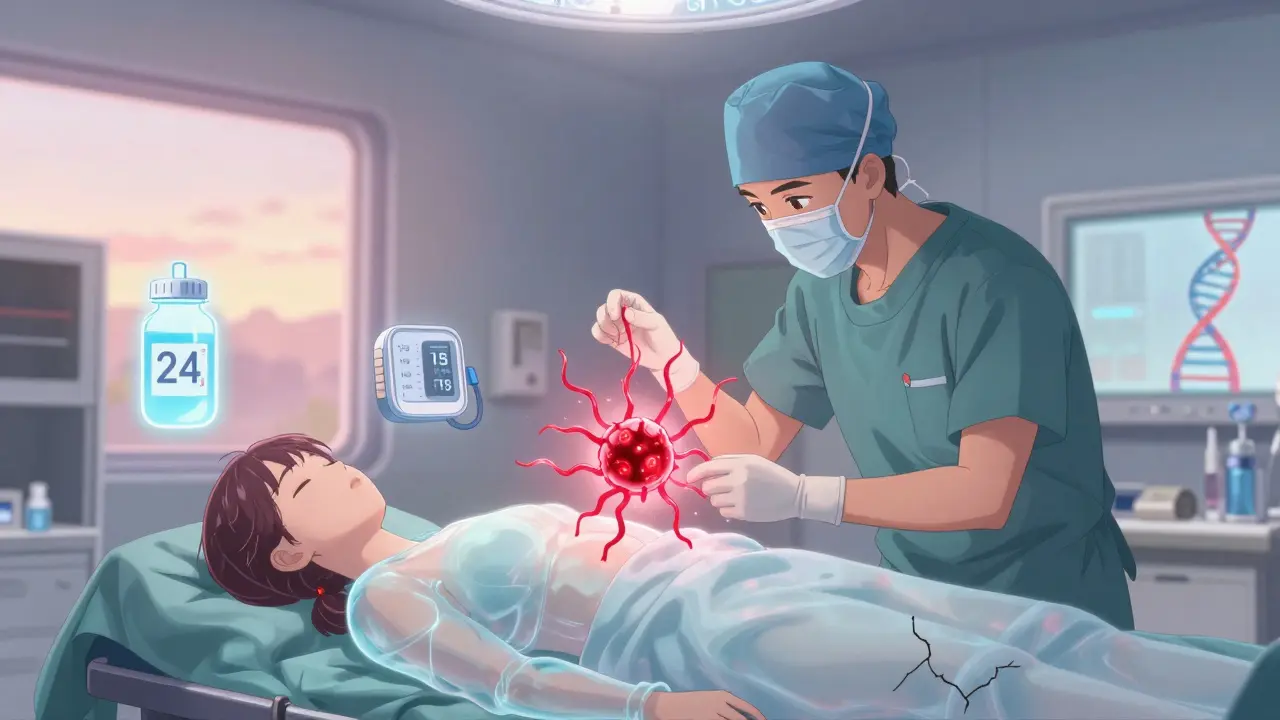
For years, pheochromocytoma was thought to be mostly random. Now we know better. Up to 40% of cases are tied to inherited gene mutations. That means if you have one, your siblings, kids, or parents might be at risk too.
The biggest culprits? Mutations in SDHB, SDHD, VHL, RET, and NF1 genes. SDHB is especially scary-it’s linked to a 30-50% lifetime risk of malignant tumors. That’s why every patient, even with no family history, now gets genetic testing. A 2023 update from the National Comprehensive Cancer Network says: test everyone. No exceptions.
Why does this matter? Because if you have an SDHB mutation, you need lifelong scans. You might develop more tumors later. You might develop metastatic disease. And if you don’t know you’re at risk, you won’t catch it early.
The Only Cure: Surgery
This is the part that makes pheochromocytoma different from almost every other cause of high blood pressure. It’s curable. Not manageable. Not controlled with pills. Cured.
After confirming the diagnosis, the next step is surgery-removing the tumor. But you can’t just walk into the OR. There’s a critical prep phase.
For 7 to 14 days before surgery, patients take alpha-blockers like phenoxybenzamine. This drug stops the tumor’s hormones from tightening blood vessels. Without it, the moment the surgeon touches the tumor, adrenaline floods the bloodstream. Blood pressure spikes. Heart goes into arrhythmia. Death risk jumps to 30-50%.
Patients also drink 2-3 liters of water a day and eat a high-sodium diet. Why? Because the tumor’s constant vasoconstriction shrinks your blood volume by 20-30%. You’re dehydrated without knowing it. Replenishing fluids prevents collapse during surgery.
Most surgeries today are done laparoscopically-small incisions, camera, precision. Recovery is quick: 1-2 days in the hospital, back to work in two weeks. Success rate? 85-90% of patients see their blood pressure normalize. Many get off all blood pressure meds within weeks.
What Happens After Surgery?
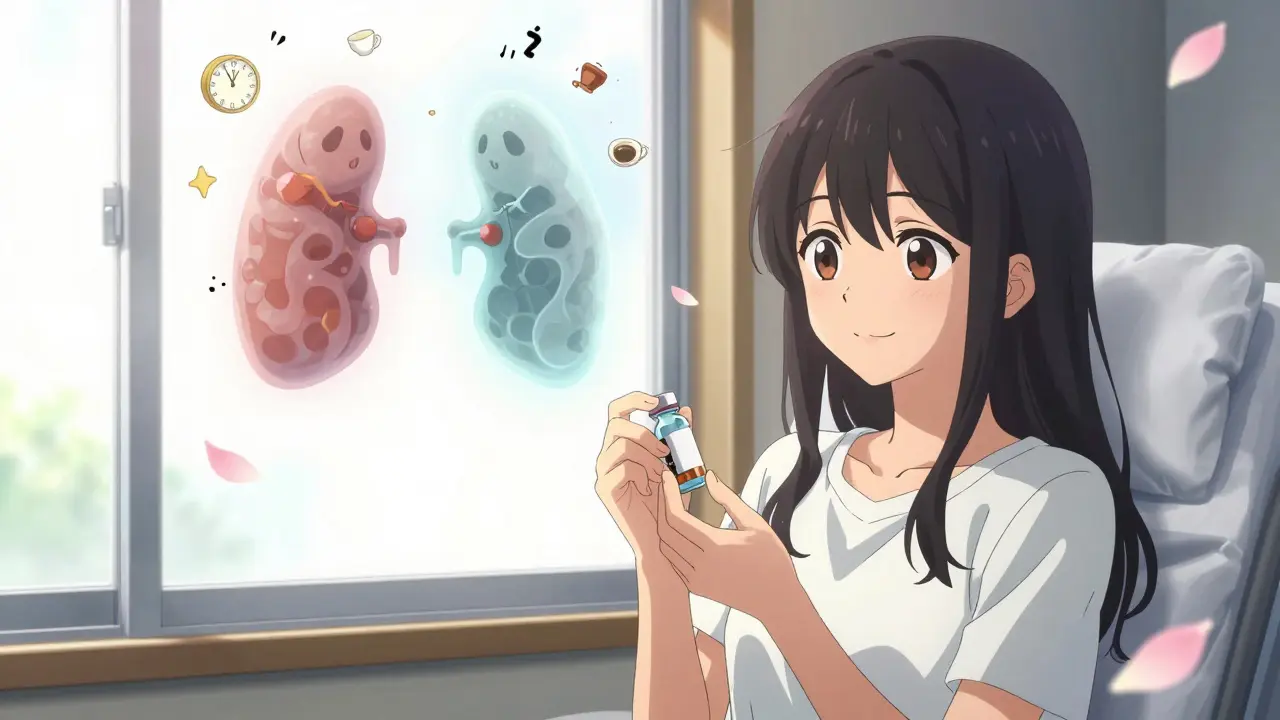
If you had one adrenal gland removed, your body usually adjusts fine. You might need temporary steroid support, but long-term? Most people don’t.
But if both glands are removed-either because of two tumors or because one was too risky to leave-you become dependent on lifelong steroid replacement. Hydrocortisone and fludrocortisone become your new normal. That’s a big trade-off. Some patients describe it as losing a part of their body’s natural rhythm.
One patient on a support forum wrote: “I developed an Addisonian crisis after bilateral surgery. Now I carry an emergency injection everywhere.” That’s real. That’s life-changing.
Even with successful surgery, 12% of patients report chronic fatigue for six months or longer. The body’s been through hell. Recovery isn’t just physical-it’s neurological. The nervous system has been overstimulated for years. It takes time to reset.
What About Malignant Pheochromocytoma?
Only 10% of cases turn malignant. But that’s still 500-1,000 new cases a year in the U.S. alone. These tumors spread-often to bones, liver, or lymph nodes. Survival drops sharply: 50% at five years.
But hope is growing. New treatments like PRRT (peptide receptor radionuclide therapy) use radioactive molecules to target tumor cells. Early trials show 65% response rates. Drugs like Belzutifan, originally for kidney cancer, are now being tested on VHL-related tumors. And liquid biopsies-detecting tumor DNA in blood-are on the horizon, promising earlier detection.
Why This Matters to You
If you’ve had unexplained high blood pressure that comes and goes, with headaches, sweating, and heart palpitations-don’t brush it off. Don’t assume it’s stress. Don’t accept an anxiety diagnosis without pushing for a metanephrine test. Ask your doctor: “Could this be a pheochromocytoma?”
If you have a family history of this tumor, or if you’ve had other related cancers like renal cell carcinoma or neuroendocrine tumors, genetic testing could save your life. And if you’re scheduled for surgery-any surgery-tell your anesthesiologist about your symptoms. This tumor can kill you in the operating room if no one knows it’s there.
Pheochromocytoma is rare. But it’s not obscure. It’s one of the few endocrine tumors that can be completely cured. And the window to catch it? It’s narrow. But it’s open.
Can pheochromocytoma be cured without surgery?
No. Surgery is the only cure. Medications like alpha-blockers can control symptoms and lower blood pressure, but they don’t remove the tumor. Without removal, the risk of sudden, life-threatening hypertension remains. Even if symptoms seem mild, the tumor can rupture or trigger a catastrophic surge at any time.
Is pheochromocytoma hereditary?
Yes, in 35-40% of cases. Mutations in genes like SDHB, SDHD, VHL, RET, and NF1 are linked to inherited forms. Even if no one in your family has had it, you could still carry a mutation. That’s why genetic testing is now recommended for every patient diagnosed with pheochromocytoma, regardless of family history.
Can stress or caffeine trigger a pheochromocytoma crisis?
Absolutely. Emotional stress, physical exertion, caffeine, alcohol, and even certain medications (like decongestants or antidepressants) can trigger hormone surges. Patients are advised to avoid these triggers before diagnosis and treatment. After surgery, most can return to normal diets, but some remain sensitive for months.
How long does it take to recover from pheochromocytoma surgery?
Most people leave the hospital in 1-2 days. They return to light work within 1-2 weeks. Full recovery-especially energy levels and nervous system balance-can take 3-6 months. If both adrenal glands were removed, lifelong hormone replacement is needed, and recovery involves adjusting to that new normal.
What happens if pheochromocytoma is missed before surgery?
It can be fatal. During surgery, touching the tumor releases a massive surge of adrenaline. Blood pressure can spike to 250/150, triggering heart attack, stroke, or cardiac arrest. Mortality rates without preoperative blockade can reach 30-50%. That’s why pre-op alpha-blockade is mandatory. Any surgeon operating on an adrenal tumor without confirming this diagnosis is taking an unacceptable risk.
Are there alternatives to laparoscopic surgery?
Yes. If the tumor is very large, attached to major blood vessels, or if there’s bleeding during surgery, the surgeon may switch to an open procedure. This means a larger incision but better control. About 5-8% of laparoscopic cases require conversion. In rare cases where surgery isn’t possible (like metastatic disease), targeted therapies like PRRT or HIF-2α inhibitors are used.
Jackie Be
December 23, 2025 AT 07:39John Hay
December 23, 2025 AT 16:27Jon Paramore
December 23, 2025 AT 17:01Swapneel Mehta
December 24, 2025 AT 00:55Jason Silva
December 25, 2025 AT 08:53mukesh matav
December 27, 2025 AT 08:00Peggy Adams
December 27, 2025 AT 12:17Sarah Williams
December 27, 2025 AT 23:11Theo Newbold
December 29, 2025 AT 22:35Jay lawch
December 30, 2025 AT 09:43Grace Rehman
December 31, 2025 AT 04:34Jerry Peterson
January 1, 2026 AT 02:28Meina Taiwo
January 1, 2026 AT 16:12Adrian Thompson
January 3, 2026 AT 08:45