
Rare Side Effect Detection Calculator
Enter Parameters
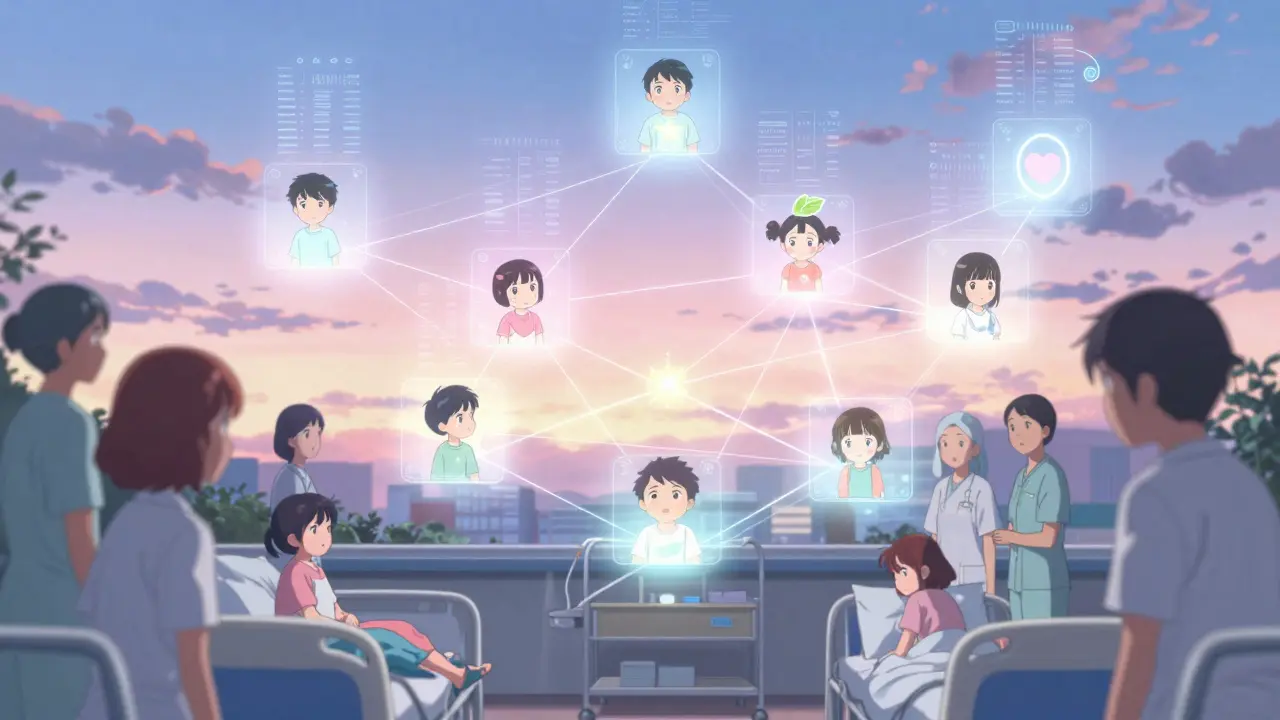
How Safety Networks Help
Unlike adults, children respond differently to medications. Rare side effects may only appear in 1 in 10,000 patients or less. Individual hospitals can't detect these risks alone because they don't see enough patients.
In this example:
- A single hospital with 1,000 patients/year would need 10 years to see this side effect.
- With 5 hospitals in the network, it would take 2 years to detect the same side effect.
Results
When a child is given a new medication or undergoes a complex medical procedure, doctors don’t always know what might go wrong. Unlike adults, kids aren’t just small versions of grown-ups - their bodies react differently, and rare side effects can hide in small patient groups. That’s why traditional clinical trials often miss what’s really happening. Enter pediatric safety networks: collaborative systems where hospitals, researchers, and public health agencies work together to find and track side effects in real time.
These networks didn’t appear out of nowhere. They were built because children have been left out of safety research for decades. In the 1990s, up to 80% of drugs used in kids had never been tested for safety in pediatric populations. Even today, many treatments are given based on adult data, adjusted for weight. But weight alone doesn’t predict how a child’s liver, kidneys, or brain will respond. That’s where these networks step in - not to replace trials, but to fill the gaps they can’t reach.
How Pediatric Safety Networks Actually Work
At the core of these networks is a simple idea: share data, share power. One major example is the Collaborative Pediatric Critical Care Research Network (CPCCRN), launched by the NIH’s Eunice Kennedy Shriver National Institute of Child Health and Human Development (NICHD) in 2014. It wasn’t just one hospital. It was seven major pediatric centers across the U.S., all connected by a single Data Coordinating Center (DCC). This DCC didn’t just collect data - it designed the tools to capture it.
Each hospital enrolled critically ill children into shared protocols. But here’s the key: they didn’t just record whether a child got better. They tracked every abnormal reaction - a sudden drop in blood pressure, an unexpected rash, a spike in liver enzymes. All of it. The DCC then pooled that data, ran statistical models, and flagged patterns no single site could see. If three hospitals noticed the same rare reaction after using a new sedative, the network could alert everyone within weeks, not years.
But it wasn’t just about data. Each network had a formal structure. A Steering Committee made decisions. A Protocol Review Committee approved new studies. And crucially, a Data and Safety Monitoring Board - made up of independent experts - had the power to pause a study if safety risks emerged. This wasn’t bureaucracy. It was a built-in early warning system.
Another Side of the Coin: Prevention Over Treatment
Not all pediatric safety networks focus on drugs. The Child Safety Collaborative Innovation and Improvement Network (CoIIN), backed by HRSA, took a different approach. Instead of hospitals, it worked with state health departments and community programs. Its goal? Prevent injuries before they happen.
One team in a Midwestern state was trying to reduce sexual violence among teens by expanding a program called Green Dot, which trains students to intervene in risky situations. At first, they assumed more training meant fewer incidents. But after collecting real-time data - not just surveys, but actual reports from schools - they found something surprising: in some schools, participation actually increased reports of minor altercations. Not because violence went up, but because students felt safer speaking up.
The network didn’t shut the program down. It helped them adapt. They changed their training materials to better explain what counts as intervention, and added support for counselors. That’s the power of a safety network: it doesn’t just detect harm - it helps fix it.

Why This Model Beats Traditional Research
Randomized controlled trials - the gold standard in medicine - don’t work well for kids in three big ways. First, you can’t ethically give a placebo to a child in intensive care. Second, rare side effects might only show up in 1 in 10,000 kids. No single hospital sees enough patients to notice. Third, kids grow fast. A drug that’s safe at age 5 might cause problems at age 12. Long-term tracking? Almost impossible in a 12-month trial.
Pediatric safety networks solve all three. They pool hundreds of thousands of patient encounters across years. They use real-world data, not lab conditions. And they’re designed to adapt. If a new side effect appears, the network doesn’t wait for a new grant. It reroutes resources, updates protocols, and shares the fix.
A 2013 study in Academic Pediatrics showed these networks were the only way to gather evidence on safety in areas where trials couldn’t be done - like how a new painkiller affects a toddler’s sleep patterns after surgery. Without this network model, we’d still be guessing.
The Hidden Costs and Real Challenges
It’s not easy. Running a network like CPCCRN or CoIIN takes serious resources. Each clinical site had to hire dedicated staff, train teams in standardized data entry, and install secure systems to protect children’s health records under HIPAA rules. One participating hospital reported spending 20 hours a month just on data collection and team meetings.
And funding? It’s temporary. The CPCCRN’s original NIH grant expired in 2014. The CoIIN completed its second cohort in 2019 with no new funding announced. That’s the biggest weakness: these networks rely on short-term grants, not permanent infrastructure. When funding ends, data stops flowing. Lessons fade. Programs stall.
Even when they’re running, tensions arise. One hospital might want to study a new antibiotic. Another wants to focus on sedation risks. The Steering Committee has to vote. Decisions get delayed. But that’s the trade-off: collaboration means compromise. And in child safety, compromise is better than silence.
What’s Next for Pediatric Safety Networks
The networks themselves may have paused, but their legacy is growing. The CPCCRN’s infrastructure became the blueprint for the newer Pediatric Trials Network, which now uses updated UG3/UH3 funding mechanisms to keep the model alive. Meanwhile, state-level safety efforts from CoIIN continue independently - some states still use the same data forms and change packages from 2018.
The next step? Integration. Right now, hospital safety data lives in one system, school injury reports in another, and pharmacy records in a third. The future is a connected network that follows a child from the ER to the classroom to the pharmacy - tracking side effects across settings, not just in clinics. Imagine a child’s digital health record that automatically flags if a new medication is linked to increased anxiety in kids their age - based on real data from 200 other hospitals.
That’s not science fiction. It’s the logical next step. And it’s built on the work of these early networks - networks that proved collaboration isn’t just nice to have. It’s essential for keeping kids safe.
What are pediatric safety networks?
Pediatric safety networks are collaborative systems where hospitals, research centers, and public health agencies work together to track and respond to side effects and safety risks in children. They use shared data, standardized protocols, and independent oversight to identify problems faster than traditional studies can.
How do these networks find rare side effects?
By combining data from multiple hospitals, they increase the number of patients tracked. A side effect that shows up in one child out of 10,000 might be missed at a single hospital. But when 10 hospitals each see 500 kids, patterns emerge. Statistical tools then confirm whether the pattern is real or random.
Why not just use regular clinical trials?
Clinical trials are controlled and short. They often exclude critically ill children or those with complex conditions. They also can’t track long-term effects or rare reactions because they don’t have enough participants. Safety networks work in real-world settings, include more diverse patients, and follow kids over time.
Are these networks still active today?
The original NIH-funded CPCCRN ended in 2014, and HRSA’s CoIIN completed its last cycle in 2019. But their methods live on. Newer networks like the Pediatric Trials Network use the same structure. Many states still use CoIIN’s tools and data systems for child safety programs.
What’s the biggest challenge these networks face?
Funding. They rely on short-term federal grants. Once funding ends, data collection stops, staff leave, and momentum fades. Without permanent infrastructure, even the most successful networks can’t sustain long-term safety monitoring.
Alfred Noble
February 24, 2026 AT 00:47still crazy how underfunded this stuff is. we’re basically running on fumes and hope.
David McKie
February 24, 2026 AT 05:55These networks are just bureaucratic nightmares that delay care. Why can’t we just trust doctors? I’ve seen kids get poisoned because some committee had to vote on whether to flag a side effect. It’s not science-it’s performance art with HIPAA forms.
And don’t get me started on ‘community programs’-teaching teens to ‘intervene’? That’s just encouraging snitch culture. I’m done.
Southern Indiana Paleontology Institute
February 26, 2026 AT 01:07my cousin’s kid got a new med and the docs didn’t even know what it did. why? because some grant ran out.
all this ‘collaboration’ is just a fancy way to say ‘we’re too lazy to fix the real problem’-which is: stop using adult drugs on kids. duh.
Anil bhardwaj
February 26, 2026 AT 18:38these networks? they’re not just smart-they’re lifesavers. hope more countries adopt this.
Joanna Reyes
February 28, 2026 AT 13:28It’s not just about data collection. It’s about trust. When a hospital in Alabama shares a pattern of liver toxicity with a hospital in Minnesota, and they both realize they’ve been missing it because they were looking at the wrong lab values-that’s when you feel like you’re actually doing something.
The funding model is broken, yes. But what’s worse is pretending this isn’t critical infrastructure. We don’t treat pediatric safety like we treat fire alarms. We should.
Nerina Devi
March 1, 2026 AT 06:44What these networks do is turn silence into safety. They don’t just collect data-they give families answers.
Thank you for writing this. It’s time we stop treating pediatric health as an afterthought.
Dinesh Dawn
March 2, 2026 AT 06:41we need more of this. not less.
Vanessa Drummond
March 4, 2026 AT 02:57Let’s be real: the real problem is that pediatric drug development is underfunded because kids aren’t profitable. These networks are just a Band-Aid on a hemorrhage.
And don’t even get me started on the CoIIN ‘involvement’ nonsense. Teaching teens to ‘intervene’? That’s not prevention-that’s social engineering. I’ve seen the data. It’s not reducing violence. It’s just increasing paperwork.
Nick Hamby
March 5, 2026 AT 02:46Traditional clinical trials operate under the assumption that control equals truth. But in pediatric medicine, truth is not found in isolation-it is revealed through convergence.
When seven hospitals, each with their own culture, their own data quirks, their own unspoken fears, begin to share not just outcomes but *observations*-when a nurse in Cincinnati notices a rash and a technician in Seattle confirms it, and a pharmacist in Chicago remembers a similar case from last winter-that is not data aggregation.
That is collective wisdom. That is the emergence of a new epistemology in medicine: one rooted not in the laboratory, but in the lived experience of vulnerable bodies.
And yet, we fund it with grants that expire. We treat it like a pilot, not a pillar.
This is not just a public health failure. It is a moral one.
kirti juneja
March 6, 2026 AT 11:16that’s basically what these networks are. just… bigger. and with better wifi.
pls fund this. our kids are counting on it.
Haley Gumm
March 6, 2026 AT 22:36How many of these ‘patterns’ are just statistical noise? How many kids got denied treatment because a network flagged a side effect that turned out to be harmless?
Also, why is HRSA involved in school programs? That’s not healthcare-that’s activism.