
Opioid-Induced Hyperalgesia Risk Assessment Tool
Opioid-Induced Hyperalgesia Risk Assessment
This tool helps estimate your risk of developing opioid-induced hyperalgesia based on your current opioid use and health factors. Opioid-induced hyperalgesia is when long-term opioid use actually makes your pain worse.
Click "Calculate Risk" to see your risk level and recommendations.
Input Your Information
Results
Key risk factors:
Recommendations based on your risk level
Imagine taking more opioid painkillers because your pain is getting worse-only to find out the pills themselves are making it worse. This isn’t a myth. It’s a real, documented condition called opioid-induced hyperalgesia (OIH). And it’s happening to more people than most doctors realize.
What Exactly Is Opioid-Induced Hyperalgesia?
Opioid-induced hyperalgesia is when long-term use of opioid pain medications-like oxycodone, morphine, or fentanyl-actually makes your nervous system more sensitive to pain. Instead of reducing pain, the drugs start amplifying it. You might feel pain from something that never hurt before, like a light touch or a breeze on your skin. This is called allodynia. Or you might find that your original pain, say from a bad back or arthritis, spreads to other parts of your body and feels sharper, even though you’re taking higher doses.This isn’t the same as tolerance. Tolerance means you need more of the drug to get the same pain relief. OIH means your body is becoming more sensitive to pain itself. It’s like turning up the volume on your pain signals instead of silencing them.
How Does It Happen? The Science Behind the Pain
Your nervous system doesn’t just shut down when you take opioids-it fights back. Over time, opioids trigger changes deep inside your spinal cord and brain. One key player is the NMDA receptor, a type of nerve cell switch that normally helps your body learn and adapt. But under prolonged opioid exposure, it gets stuck in the “on” position. This causes a chain reaction: more calcium floods into nerve cells, more pain-signaling chemicals like glutamate are released, and your body starts interpreting even harmless touches as painful.Another mechanism involves dynorphin, a natural brain chemical that, under opioid influence, starts promoting pain instead of blocking it. Then there’s the role of opioid metabolites-waste products your body makes when breaking down drugs like morphine. In people with kidney problems, these metabolites build up and directly irritate nerve cells, making pain worse.
Genetics also matter. Some people have a version of the COMT gene that breaks down pain-regulating chemicals like dopamine and norepinephrine more slowly. These individuals are more likely to develop OIH, even at lower opioid doses. It’s not just about how much you take-it’s about how your body is wired.
Who’s at Risk?
OIH doesn’t happen to everyone, but certain groups are more vulnerable:- People on high-dose opioids, especially intravenous or long-acting forms like hydromorphone or fentanyl patches
- Those with kidney disease, where opioid byproducts accumulate
- Patients on opioids for more than a few months
- Individuals with low-activity COMT gene variants
- People who’ve had surgery with high intraoperative opioid doses
It’s most common in chronic pain patients and palliative care settings, where opioids are used for weeks or years. But even people on moderate doses for a year or more can develop it. Studies suggest 2% to 10% of long-term opioid users experience OIH-but because it’s so often mistaken for something else, the real number could be higher.
How Is It Different From Tolerance or Disease Progression?
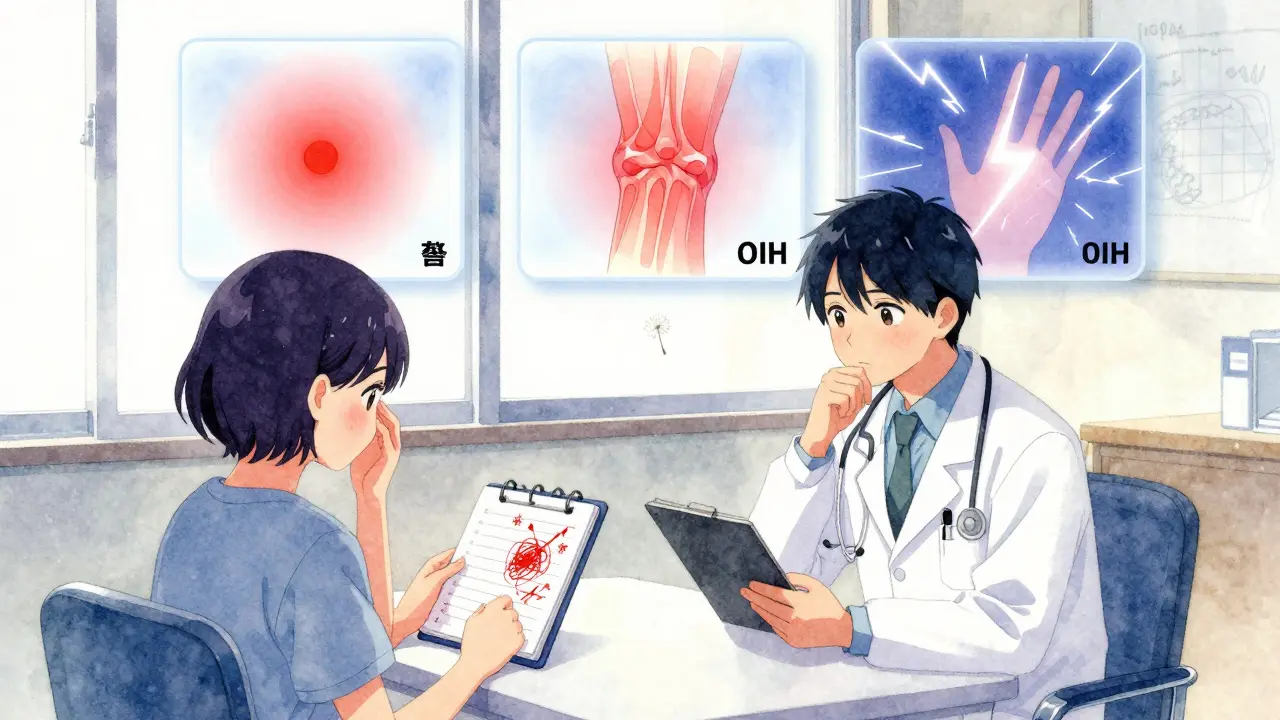
This is where things get tricky-and why OIH is so often missed.- Tolerance: You need more opioids to get the same pain relief. The pain itself hasn’t changed-just your body’s response to the drug.
- Disease progression: Your original condition, like arthritis or cancer, is getting worse. The pain is localized and follows the expected pattern.
- OIH: Pain gets worse despite higher opioid doses. It spreads beyond the original area. You develop allodynia-pain from light touch, cold, or even clothing. Pain may feel more burning, electric, or widespread.
One telltale sign? If you lower your opioid dose and your pain actually improves, that’s a strong clue you’re dealing with OIH-not tolerance or disease progression.
What Does Diagnosis Look Like?
There’s no blood test or scan for OIH. Diagnosis is based on clinical patterns. Doctors look for:- Pain worsening with increasing opioid doses
- Pain spreading to areas that weren’t originally affected
- Allodynia or heightened sensitivity to non-painful stimuli
- No new injury, infection, or tumor to explain the change
Some clinics use quantitative sensory testing-like applying controlled heat or pressure to measure pain thresholds. If your pain threshold drops in areas far from your original injury, that’s a red flag. But most diagnoses still rely on careful history-taking and ruling out other causes.
The problem? Many doctors still don’t recognize OIH. A 2020 survey found only 35% of pain specialists felt confident diagnosing it. That means a lot of people are stuck in a cycle: more pain → higher doses → even more pain.
How Is It Treated?
The good news? OIH can be reversed. The key is stopping the thing that’s causing it-opioids.Here’s what actually works:
- Reduce the opioid dose: Yes, it sounds counterintuitive. But lowering the dose often leads to a drop in pain intensity. Your nervous system slowly resets.
- Switch to methadone: Methadone isn’t just another opioid. It also blocks NMDA receptors, the same ones that drive OIH. Studies show switching to methadone can cut post-surgery painkiller needs by 40%.
- Add NMDA blockers: Low-dose ketamine (given through IV or nasal spray) or magnesium sulfate can calm overactive pain pathways. These aren’t first-line, but they help when opioids aren’t working.
- Use gabapentin or pregabalin: These drugs calm overexcited nerves by targeting calcium channels. They’re especially useful for burning, shooting pain.
- Try non-drug therapies: Cognitive behavioral therapy (CBT) helps retrain how your brain processes pain. Physical therapy, mindfulness, and graded movement can rebuild tolerance to activity without triggering pain spikes.
It’s not about replacing one drug with another. It’s about breaking the cycle of sensitization. And that takes time-weeks, sometimes months. But patients who make the switch often report not just less pain, but better sleep, mood, and function.
Why This Matters More Than You Think
OIH isn’t just a niche problem. It’s a hidden driver of the opioid crisis. When people feel their pain isn’t improving, doctors often respond by prescribing more pills. That’s exactly what makes OIH worse. It’s a vicious loop: more opioids → more pain → more prescriptions → more risk of dependence.And it’s especially dangerous in cancer and end-of-life care. Patients are already vulnerable. If their pain is misdiagnosed as disease progression, they may be pushed into higher and higher doses, increasing side effects like confusion, constipation, and respiratory depression-all without real benefit.
Research is moving forward. Scientists are testing new drugs that target kappa-opioid receptors, which may relieve pain without triggering hyperalgesia. Others are looking for genetic markers to predict who’s at risk before they even start opioids.
What Should You Do If You Suspect OIH?
If you’ve been on opioids for months and your pain is spreading, getting worse, or now hurt from light touch, talk to your doctor. Don’t stop cold turkey-that can cause withdrawal. But do ask:- Could this be opioid-induced hyperalgesia?
- Can we try slowly lowering my dose?
- Would switching to methadone help?
- Can we add gabapentin or start physical therapy?
Bring a pain diary. Note when pain worsens, what triggers it, and how your dose changes. That data is gold for diagnosis.
Remember: needing more opioids doesn’t mean you’re failing. It might mean your body’s trying to tell you something. OIH is real. And it’s treatable-if you know what to look for.
Is opioid-induced hyperalgesia the same as opioid tolerance?
No. Tolerance means you need higher doses to get the same pain relief, but your baseline pain hasn’t changed. OIH means your nervous system has become more sensitive to pain itself-you feel more pain even though you’re taking more opioids. In tolerance, pain stays where it was. In OIH, pain spreads and becomes more intense with light touch.
Can you get OIH from short-term opioid use?
It’s rare, but possible. Most cases develop after weeks or months of regular use. However, high-dose intraoperative opioids during surgery have been linked to increased postoperative pain, suggesting even brief exposure can trigger early sensitization in some people.
Does everyone on opioids get OIH?
No. Studies estimate only 2% to 10% of long-term opioid users develop OIH. Risk depends on dose, duration, genetics, kidney function, and type of opioid. People with kidney disease or certain gene variants are at higher risk.
Can you reverse OIH completely?
Yes, in many cases. Reducing or switching opioids often leads to significant pain improvement over weeks to months. Adding medications like gabapentin or ketamine helps speed recovery. Most patients report better pain control and fewer side effects once the hyperalgesic cycle is broken.
Why don’t more doctors know about OIH?
OIH is under-taught in medical training. Symptoms overlap with tolerance, withdrawal, or disease progression. There’s no lab test, so diagnosis relies on clinical judgment. A 2020 survey showed only 35% of pain specialists felt confident diagnosing it. Awareness is growing, but many patients still go undiagnosed for years.
Juan Reibelo
January 24, 2026 AT 05:11Wow. This is the most clear, well-researched explanation of OIH I’ve ever read. I’ve been on oxycodone for six years-my pain spread from my lower back to my feet, and even my shirt felt like sandpaper. I thought I was just getting worse. Turns out, I was being poisoned by the very thing meant to help me. Thank you for putting this out there.
Dolores Rider
January 25, 2026 AT 23:47They’re lying. This is all part of the pharma cover-up. They don’t want you to know opioids make you hurt more because then you’d stop buying them. The FDA, doctors, and Big Pharma-they’re all in bed together. 😡💉
Vatsal Patel
January 27, 2026 AT 19:28So let me get this straight-we’ve created a system where the solution to pain becomes the cause of it? How is this not the ultimate metaphor for modern life? We take drugs to escape suffering, only to become slaves to the very mechanism we hoped would free us. The universe laughs. 🤷♂️
Sharon Biggins
January 29, 2026 AT 07:31you’re not alone!! i’ve been there too… it took me 3 years to figure out it wasn’t me failing-it was the meds. i switched to gabapentin and started yoga and i’m sleeping again 😭 thank you for sharing this!!
John McGuirk
January 29, 2026 AT 15:11They’re just trying to get you hooked. You think this is about pain? Nah. It’s about profit. Opioids are a cash cow. The more you hurt, the more they sell. They don’t care if you’re dead or alive-just as long as you’re buying. I’ve seen it. My cousin OD’d after 18 months on fentanyl patches. They called it 'accidental.' Liar.
lorraine england
January 29, 2026 AT 21:28This is so important. I’ve had patients describe exactly this-pain spreading, touching their skin feels like fire. I used to think they were exaggerating. Now I know better. I wish I’d known this five years ago.
Himanshu Singh
January 30, 2026 AT 20:26Life’s funny. We reach for comfort, but comfort becomes the cage. Opioids promise relief but deliver a mirror-showing us how fragile our nervous systems really are. Maybe the real pain wasn’t the injury… it was the illusion that pills could fix everything. 🌱
Helen Leite
January 31, 2026 AT 09:53OMG I knew it!! I told my doctor 'this isn't right' and he just wrote me another script 😭 I had to stop cold turkey and now I'm in withdrawal but at least my skin doesn't feel like it's on fire anymore. 🙏💊 #OIHIsReal
Marlon Mentolaroc
February 2, 2026 AT 01:36Let’s be real-this is just a fancy way of saying 'you got addicted.' You didn’t develop a new disease. You just built up tolerance and now you’re scared to quit. The science here is cherry-picked to scare people off opioids. Don’t fall for it.
Gina Beard
February 2, 2026 AT 09:27It’s not about the drugs. It’s about the silence.
siva lingam
February 3, 2026 AT 00:51So you took pills. You got addicted. Now you blame the pills. Shocking.
Sawyer Vitela
February 4, 2026 AT 16:23Study says 2-10%. That’s not a crisis. That’s noise. You’re 10x more likely to die from a car crash than develop OIH. Stop fearmongering.
Tiffany Wagner
February 4, 2026 AT 21:33i’ve been on low dose hydrocodone for 18 months and my hands started tingling and my back pain got worse even though i took more… i thought i was crazy. this makes so much sense now. thank you
Amelia Williams
February 6, 2026 AT 15:33This is exactly why I started physical therapy and meditation. I didn’t know OIH was a thing, but I knew something was off. When I cut my dose by 30%, my pain dropped 40%. It felt like my body finally breathed again. You’re not broken-you’re just sensitized. And that’s reversible. You’ve got this 💪❤️