

When melanoma is caught early, your chances of survival are better than 99%. But if it spreads, that number drops to just 32%. This isn’t just a skin issue - it’s a race against time. Every year, more people are diagnosed with melanoma, and while treatments have improved dramatically, the real game-changer isn’t just the drugs - it’s early detection.
How Melanoma Starts and Why Timing Matters
Melanoma begins in melanocytes, the cells that give your skin its color. Most start as moles or dark spots, but not all moles are dangerous. The tricky part? Some turn cancerous fast. Unlike other skin cancers that grow slowly, melanoma can spread to lymph nodes or organs in weeks. That’s why waiting to see if a spot changes isn’t just risky - it’s dangerous.
The ABCDE rule still works: Asymmetry, Border irregularity, Color variation, Diameter larger than 6mm, and Evolving shape or color. But even experienced doctors miss up to 40% of early melanomas during visual checks. That’s where new tools are making a real difference.
AI Is Changing How Melanoma Is Found
For years, dermatologists relied on dermoscopes - handheld magnifiers that let them see below the skin’s surface. Now, AI is stepping in. Systems like SegFusion, developed at Northeastern University, combine image segmentation and classification to analyze skin lesions with 99% accuracy. It doesn’t just guess - it isolates the exact area of concern before making a call.
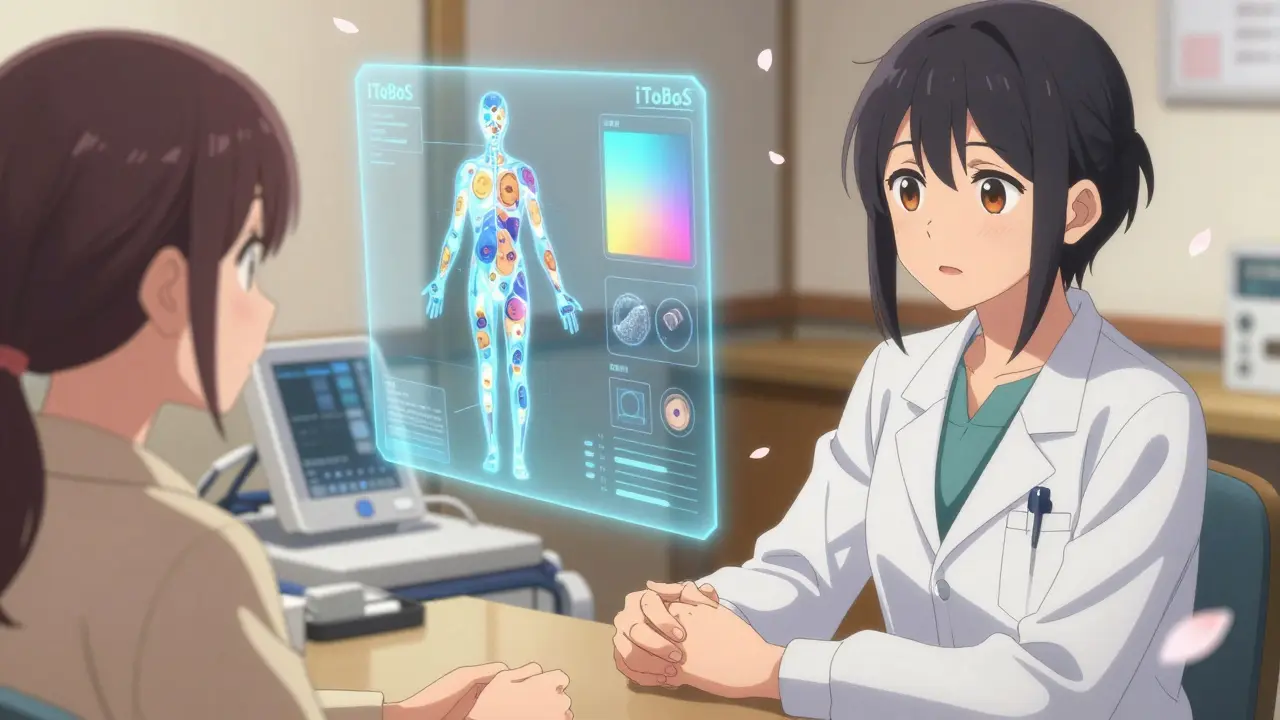
Other tools are even more advanced. The iToBoS full-body scanner, backed by 20 European research teams, takes six minutes to scan your entire skin. It maps every mole, spots anomalies, and flags high-risk areas using explainable AI. That means doctors don’t just get a warning - they see why the system flagged it. Is it the shape? The color gradient? The texture? The AI shows its work.
Even simpler tools are making waves. DermaSensor, approved by the FDA in January 2024, uses near-infrared light to measure how skin scatters and absorbs light. It’s about the size of a pen, costs under $500, and can be used by primary care doctors with just 2-3 hours of training. In trials, it boosted diagnostic confidence by 87%. But here’s the catch: its specificity is low - between 26% and 40%. That means it flags a lot of harmless spots. For every true melanoma it catches, it might send three or four people for unnecessary biopsies.
The Real Problem: Bias and False Alarms
AI tools trained mostly on light skin tones perform 12-15% worse on darker skin. A 2025 JAMA Dermatology study found that algorithms missed more melanomas in people with Fitzpatrick skin types IV-VI. That’s not a glitch - it’s a design flaw. If your training data doesn’t reflect real-world diversity, the tool won’t either.
And then there’s overdiagnosis. Some experts warn that screening too aggressively leads to detecting melanomas that would never have spread. A 2025 study in Taylor & Francis found that early detection might be causing more harm than good in low-risk cases - unnecessary surgeries, anxiety, and scarring for cancers that wouldn’t have killed you.
Still, for high-risk patients - those with family history, many moles, or past melanoma - these tools are lifesavers. The key isn’t replacing doctors. It’s giving them better data.
What’s Next: Wearables and Home Screening
At Wake Forest University, researchers built a battery-free, wireless patch that sticks to your skin and measures bioimpedance - how easily electrical current flows through tissue. Cancerous cells conduct electricity differently than healthy ones. In a small trial with 10 volunteers, the patch showed clear differences between benign and malignant lesions (p<0.05).
Imagine this: you wear the patch for a week. It silently monitors changes. At your annual check-up, your doctor plugs it into a small reader. No camera. No light. Just data. The team is now testing conductive hydrogel electrodes to make it stick better and last longer. This isn’t science fiction - it’s coming to clinics by 2027.
Immunotherapy: Turning Your Body Into a Cancer Fighter
If melanoma has spread, surgery isn’t enough. That’s where immunotherapy comes in. Before 2011, metastatic melanoma meant a life expectancy of under a year. Now, many patients live for years - some, indefinitely.
How? By removing the brakes on your immune system. Drugs like pembrolizumab and nivolumab block PD-1, a protein that tells immune cells to stand down. Others, like ipilimumab, block CTLA-4, another off-switch. When you combine them, response rates jump to over 50%. In a 2025 study, 37% of patients had no signs of cancer after two years.
Newer drugs are even more targeted. Regeneron’s fianlimab, paired with a PD-1 blocker, is showing promise in Phase 3 trials. Meanwhile, IMA203 PRAME cell therapy - a personalized treatment that trains your T-cells to hunt melanoma cells - achieved a 56% complete response rate in early trials. It’s not for everyone. Only those with the HLA-A*02:01 gene marker qualify. But for them, it’s a game-changer.
How Treatment Is Chosen Today
Not everyone gets the same drugs. Doctors consider:
- Stage of cancer (localized, regional, or metastatic)
- Genetic mutations (BRAF, NRAS, or KIT mutations)
- Overall health and immune status
- Prior treatments
If you have a BRAF mutation, targeted therapy (like dabrafenib + trametinib) might come first. If not, immunotherapy is the go-to. Many patients now get both - immunotherapy first, then targeted therapy if it fails. The order matters.
Side effects vary. Immunotherapy can cause fatigue, rash, or colitis. In rare cases, it triggers autoimmune reactions - the immune system attacks the liver, lungs, or thyroid. But these are manageable with steroids and close monitoring. The trade-off? A shot at long-term survival.

What’s Working in Real Clinics
Cleveland Clinic cut unnecessary biopsies by 28% after using DermaSensor. Mayo Clinic rolled out AI-assisted screening across 22 locations in 2025. European clinics using iToBoS reported 78% satisfaction with detection accuracy - even with a 35% false positive rate. That’s still better than the 60-70% sensitivity of human visual exams.
But adoption isn’t uniform. Smaller practices struggle with integration. AI tools need 6-8 weeks to plug into electronic records. Staff training can take 15-20 hours. DermaSensor? Just 2-3 hours. That’s why it’s spreading faster.
What You Can Do Today
You don’t need a high-tech scanner to save your life. Here’s what actually works:
- Check your skin monthly. Use a mirror. Look for new spots or changing moles.
- Get professional skin checks yearly - especially if you have 50+ moles, a family history, or past sunburns.
- Know your risk. Fair skin, red hair, or a history of tanning beds? You’re in a higher-risk group.
- Don’t ignore spots on your scalp, soles, or under nails. Melanoma hides there too.
- Ask your doctor about AI tools. If they’re using them, ask how they’re validated.
And if you’re diagnosed? Ask about immunotherapy. Ask about clinical trials. Ask if genetic testing is right for you. The old rule - “melanoma means death” - is gone. Today, it’s about smart detection and smart treatment.
Can melanoma be detected before it becomes dangerous?
Yes. When caught at Stage 0 or Stage I - before it spreads beyond the top layer of skin - survival rates are over 99%. Tools like dermoscopy, AI imaging, and even wearable patches can detect changes years before symptoms appear. The key is regular skin checks and using technology to catch what the eye misses.
Are AI skin scanners reliable?
They’re very accurate in controlled settings - some reach 96% accuracy on standardized images. But real-world performance drops due to lighting, skin tone, and lesion variation. Tools like SegFusion and iToBoS are designed to handle this, but simpler devices like DermaSensor have lower specificity, leading to false alarms. AI is a tool, not a replacement for a dermatologist’s judgment.
Does immunotherapy work for everyone with melanoma?
No. Immunotherapy works best for people whose tumors have high mutation loads or express certain proteins like PD-L1. Around 40-50% of metastatic melanoma patients respond well. Others need targeted therapy, radiation, or clinical trials. Genetic testing helps determine the best path. New treatments like IMA203 PRAME cell therapy are expanding options for those who don’t respond to current drugs.
Can I use AI tools at home?
Not yet. Most AI diagnostic tools require FDA or CE approval and are restricted to clinical settings. Apps that analyze photos of moles are not reliable and can give false reassurance. The only home-based option under development is the wearable bioimpedance patch from Wake Forest - still in trials. For now, self-checks and professional visits remain the gold standard.
Why do some melanoma treatments cause autoimmune side effects?
Immunotherapy drugs remove the brakes on your immune system. That lets T-cells attack cancer - but sometimes they also attack healthy tissue. This can cause inflammation in the colon (colitis), lungs (pneumonitis), thyroid, or skin. Most side effects are mild and managed with steroids. Severe cases are rare but require stopping treatment. Doctors monitor patients closely during therapy to catch issues early.
What’s on the Horizon
By 2030, AI-assisted detection could become standard. Imagine a full-body scan during your annual physical. Your phone alerts you to a new mole. Your doctor gets a report with risk scores, not just images. You get a personalized plan based on genetics, lifestyle, and past lesions.
And immunotherapy? It’s moving toward personalization. Treatments will be tailored to your tumor’s unique mutations - not just your skin type. Clinical trials are already testing vaccines that train your immune system to recognize your specific cancer.
The future isn’t about one magic bullet. It’s about layers: early detection, precise diagnosis, smart treatment, and continuous monitoring. Melanoma is still deadly - but now, it’s beatable.
Andrew Poulin
March 8, 2026 AT 03:43Weston Potgieter
March 10, 2026 AT 02:42phyllis bourassa
March 11, 2026 AT 00:23Ian Kiplagat
March 11, 2026 AT 06:45Bridget Verwey
March 13, 2026 AT 03:55Jeff Mirisola
March 13, 2026 AT 08:39Vikas Verma
March 14, 2026 AT 14:09Ferdinand Aton
March 14, 2026 AT 22:53Joe Prism
March 16, 2026 AT 19:57William Minks
March 17, 2026 AT 03:18Sean Callahan
March 18, 2026 AT 04:05Susan Purney Mark
March 18, 2026 AT 05:43Adebayo Muhammad
March 19, 2026 AT 22:15