
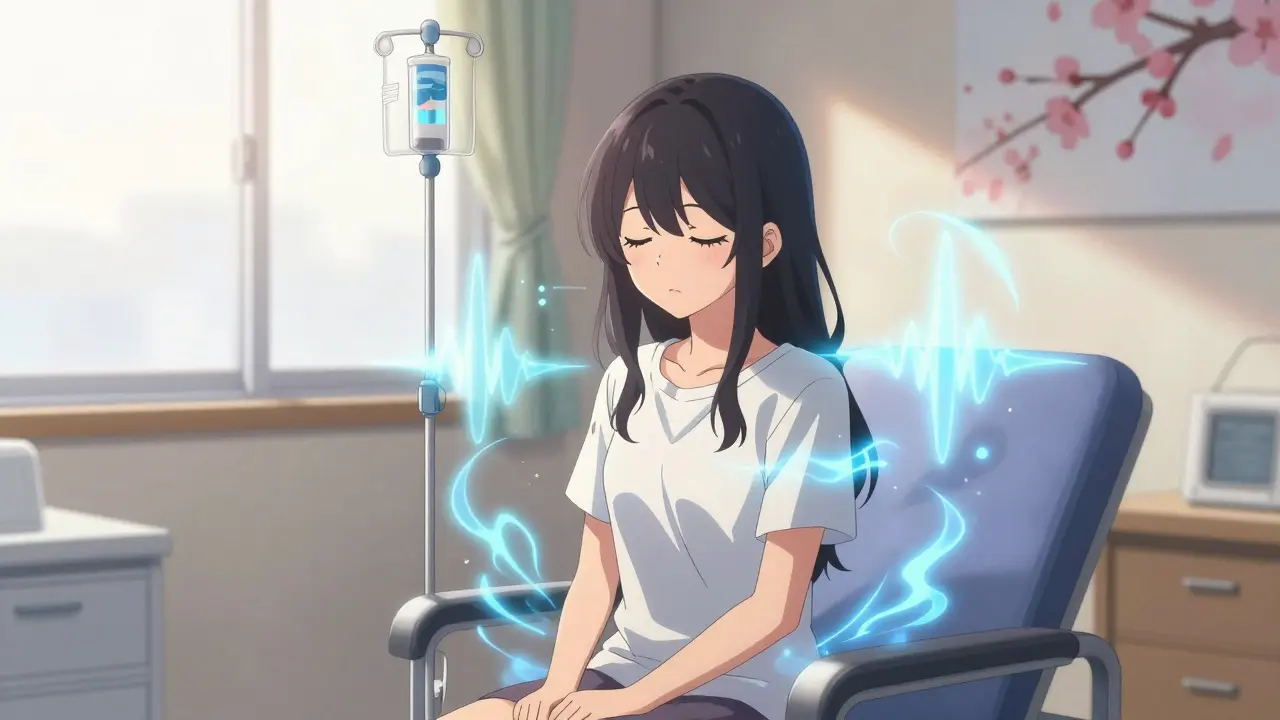
When standard antidepressants don’t work, what’s next? For many people with treatment-resistant depression, the answer isn’t another pill-it’s ketamine or esketamine. These aren’t new drugs, but their use for depression is. Both work fast, often lifting symptoms within hours or days, not weeks. And that’s a game-changer for people who’ve spent years stuck in a dark place with no relief.
How They’re Different
Ketamine and esketamine are closely related, but not the same. Ketamine is the original drug, first approved in 1970 as an anesthetic. It’s a mix of two mirror-image molecules: (R)-ketamine and (S)-ketamine. Esketamine is just the (S)-ketamine part. That small difference changes how they act in the brain-and how they’re given.
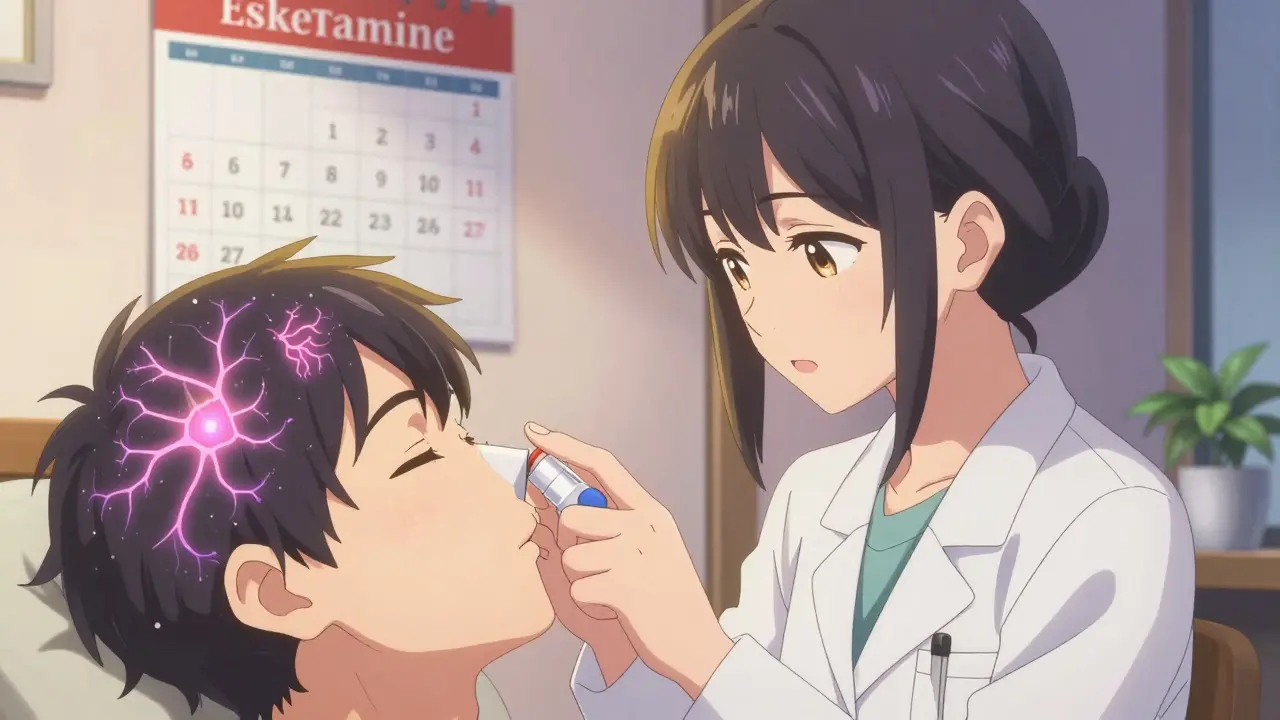
Ketamine is usually given through an IV, slowly over 40 minutes. Esketamine is a nasal spray, called Spravato®, and is self-administered under medical supervision. The IV route lets doctors control the dose precisely. The nasal spray is easier to handle but delivers less of the active ingredient into the bloodstream.
Which One Works Better?
A major 2025 study from Harvard-affiliated McLean Hospital looked at 153 patients with treatment-resistant depression. 111 got IV ketamine. 42 got esketamine. The results were clear: IV ketamine worked faster and more strongly.
- Ketamine users saw a 49.22% drop in depression scores after their full course.
- Esketamine users saw a 39.55% drop.
And timing mattered. With ketamine, many felt better after just one session. With esketamine, it took two treatments before symptoms started to lift. That’s critical for people in crisis. If you’re suicidal or completely frozen by depression, waiting days for relief isn’t an option.
Side Effects and Safety
Both drugs can cause dissociation-feeling detached from your body or surroundings. It’s not fun, but it’s usually short-lived. In the same 2025 study:
- 42.3% of ketamine users had dissociation.
- Only 28.7% of esketamine users did.
That’s because esketamine is a purer molecule and doesn’t trigger as many brain pathways. But ketamine’s stronger effect also means it’s more likely to help someone who’s deeply depressed. The trade-off? More intense side effects for better results.
Esketamine has a better safety profile for outpatient use. It doesn’t require an IV line or deep sedation monitoring. Ketamine, on the other hand, needs providers trained in airway management. That’s why you can’t just walk into a clinic and get it-you need a specific setting.
Cost and Access
Money matters. A full course of eight IV ketamine infusions costs between $4,200 and $5,600. A comparable course of Spravato® runs $5,800 to $6,900. So why would anyone pick the pricier option?
Insurance. In 2025, 67.4% of commercial insurers covered Spravato®. Only 38.2% covered IV ketamine. That’s because esketamine is FDA-approved for depression. Ketamine isn’t. Even though doctors have been using it safely for over a decade, insurers see it as "off-label." That means many patients pay out-of-pocket for ketamine-or can’t get it at all.
And access? Only 12.4% of U.S. counties have a certified Spravato® center. Fewer still offer IV ketamine. If you live outside a major city, finding treatment might mean driving hours-or waiting months.
Who Gets Which One?
Experts don’t agree on one-size-fits-all. Dr. John Krystal from Yale says ketamine is best for life-threatening depression. "If someone is actively suicidal, you need the fastest, strongest tool," he said in a 2025 editorial.
Dr. Christine Denny from Columbia sees esketamine differently. "It’s better for maintenance," she wrote. "People can come in, spray it, go home. It fits into life. Ketamine doesn’t."
Real-world feedback backs this up. On PatientsLikeMe, 63.2% of IV ketamine users said they felt relief within 24 hours. But 78.4% of esketamine users rated their overall experience as "good" or "excellent." Why? Less scary side effects. No needles. No long recovery time.

Long-Term Use and Future Options
Neither drug is a cure. Both need maintenance. After the initial phase, patients typically get booster doses every 1 to 3 weeks. One 2024 study found that 56.3% of ketamine responders stayed in remission at six months. Esketamine’s rate was 48.7%.
Science is moving fast. New research from November 2025 found that changes in brainwave patterns-specifically increased gamma power in the frontoparietal region-could predict who will respond. That means one day, a simple EEG might tell your doctor if ketamine will work for you, before you even start.
And new delivery methods are coming. Intramuscular ketamine is now in phase 3 trials. It could offer a middle ground: faster than nasal spray, less invasive than IV. If approved, it might change the game again.
What’s the Bottom Line?
If you’ve tried two or more antidepressants and still feel hopeless, ketamine or esketamine might be worth discussing. Neither is perfect. Ketamine works faster and stronger, but it’s harder to access and more expensive if insurance won’t cover it. Esketamine is more convenient, better covered, and gentler-but it may not be enough for the most severe cases.
Both require medical supervision. You can’t just buy them online. And both carry risks: dissociation, elevated blood pressure, potential for misuse. But for people who’ve run out of options, they offer something rare: hope that works in days, not months.
What’s clear? The future of depression treatment isn’t just another pill. It’s a shift-toward fast-acting, brain-targeted therapies that don’t just mask symptoms, but reset how the brain works. Ketamine and esketamine aren’t the end. They’re the beginning.
Can ketamine or esketamine be used at home?
No. Both require administration under medical supervision with mandatory 2-hour monitoring after each dose. This is due to risks like dissociation, elevated blood pressure, and potential for misuse. Even though esketamine is a nasal spray, it must be given in a certified clinic, not at home.
Is esketamine better than ketamine for long-term use?
Esketamine may be more practical for maintenance because it’s easier to schedule, less disruptive, and has fewer intense side effects. But ketamine shows slightly better long-term remission rates. The choice depends on your symptoms, access to clinics, and how well you tolerate dissociation.
Why isn’t IV ketamine FDA-approved for depression?
Ketamine is FDA-approved only as an anesthetic. Its antidepressant use is off-label because the manufacturer never submitted the full data package required for depression approval. Esketamine, developed as a new drug specifically for depression, went through the full approval process and got the green light in 2019.
Do I need to stop my current antidepressant to start ketamine or esketamine?
No. Esketamine is approved for use alongside oral antidepressants. For IV ketamine, most clinicians also keep patients on their existing meds. Stopping antidepressants suddenly can worsen symptoms. The goal is to combine treatments, not replace them.
How soon can I expect results from ketamine or esketamine?
Some people feel better within hours after the first IV ketamine dose. With esketamine, it usually takes two doses-about a week-before noticeable improvement. Most patients see clear changes by the fourth or fifth session.
Are there long-term side effects of using ketamine or esketamine?
Long-term data is still limited. Chronic, frequent use may affect bladder health or memory, but these risks are mostly tied to recreational misuse, not medical dosing. Under professional care, with controlled frequency, serious long-term effects are rare. Monitoring and dose limits help minimize risks.
Can I drive after receiving ketamine or esketamine?
No. Both drugs cause dizziness, dissociation, and impaired coordination. You must arrange for someone to drive you home after each session. You’re not allowed to drive or operate heavy machinery for at least 24 hours after treatment.
Is ketamine or esketamine covered by Medicare?
Medicare Part B covers Spravato® (esketamine) when administered in a certified clinic, as it’s FDA-approved. IV ketamine is generally not covered by Medicare because it’s off-label. Some Medicare Advantage plans may cover it on a case-by-case basis, but you’ll likely need prior authorization and proof of treatment failure.
trudale hampton
March 22, 2026 AT 12:30Man, I never thought I'd see the day when depression treatment moved beyond waiting weeks for a pill to work. This whole ketamine thing feels like science fiction becoming real.
My cousin tried IV ketamine last year after six different SSRIs failed. Said the first session felt like floating through a dream-but by the next day, he could actually get out of bed without crying. That’s not magic. That’s medicine.
Bryan Woody
March 22, 2026 AT 19:19Let’s be real-esketamine’s just Big Pharma’s way of repackaging ketamine so they can charge $700 per spray and still get insurance to pay for it.
Ketamine works better, costs less, and has more data behind it. The only reason Spravato exists is because someone figured out how to patent a molecule and slap a fancy name on it.
Meanwhile, people in rural areas still can’t even find a clinic that offers either. This isn’t progress. It’s a billing code with dissociation.
Allison Priole
March 23, 2026 AT 11:11i just want to say… i’ve been on 12 meds over 9 years and nothing ever clicked until my doc said ‘try ketamine’
first time i did it i cried for like 20 minutes after, not because i was sad-but because i felt… light. like my brain had been carrying a rock for a decade and suddenly it was gone
side effects? yeah, i felt like i was in a sci-fi movie for an hour. but worth every second.
esketamine? i tried it once. felt like a nasal spray with a side of nothing. no rush, no shift, no ‘oh wow’ moment.
if you’re barely hanging on, go for the IV. it’s not pretty but it’s real.
Paul Cuccurullo
March 23, 2026 AT 18:10It’s astonishing how far we’ve come in psychiatric care. The notion that a dissociative anesthetic from the 1970s could be the most effective intervention for treatment-resistant depression speaks volumes about the limitations of our prior models.
While esketamine offers regulatory convenience and insurance compatibility, the clinical superiority of IV ketamine in both speed and magnitude of response cannot be ignored.
It is not merely a pharmacological intervention-it is a neurobiological reset. We are witnessing the dawn of a new paradigm in mental health treatment, one that prioritizes rapid neural plasticity over gradual serotonin modulation.
Let us not confuse accessibility with efficacy. For those in acute crisis, time is not a variable-it is the currency of survival.
Timothy Olcott
March 25, 2026 AT 05:57AMERICA BROKE. INSURANCE WON’T COVER KETAMINE BUT WILL PAY $6K FOR A NASAL SPRAY??
WE NEED TO FIX THIS. 🇺🇸😭
my uncle got IV ketamine out of pocket. paid $5k. now he’s working again. no more suicide texts.
why is this not a national emergency??
if you’re reading this and you’re struggling-DON’T GIVE UP. ASK FOR KETAMINE. IT WORKS.
PS: I’M NOT A DOCTOR BUT I HAVE A GOOGLE ACCOUNT AND I KNOW WHAT I SAW
Kyle Young
March 26, 2026 AT 09:55What’s fascinating isn’t just the efficacy, but the mechanism. Ketamine doesn’t just increase serotonin or dopamine-it rebuilds synaptic connections that have atrophied from chronic depression.
This isn’t symptom management. It’s neuroregeneration.
The fact that we can now observe measurable changes in gamma wave activity as a predictor of response suggests we’re entering an era of truly personalized neuropsychiatry.
One day, we may map a patient’s brainwave signature and algorithmically determine whether they’ll respond to ketamine, TMS, or something yet undiscovered.
What we’re seeing here isn’t a drug. It’s a new language for the brain.
Emily Hager
March 28, 2026 AT 08:04One must question the ethical implications of promoting a Schedule III substance as a first-line intervention for a condition that, historically, has been treated with psychosocial and pharmacological nuance.
While anecdotal reports of efficacy are compelling, the long-term neurocognitive consequences remain insufficiently studied.
Moreover, the commercialization of this treatment, particularly through corporate clinics with aggressive marketing tactics, raises concerns regarding patient vulnerability and informed consent.
One cannot help but draw parallels to the opioid epidemic-where rapid adoption outpaced rigorous evaluation, resulting in widespread harm.
Caution, not celebration, should be our guiding principle.
Amadi Kenneth
March 28, 2026 AT 08:43THEY’RE USING KETAMINE TO CONTROL THE MASSES. DID YOU KNOW THE GOVERNMENT HAS BEEN TESTING THIS ON VETS SINCE 2008? THEY’RE NOT FIXING DEPRESSION-THEY’RE RESETTING YOUR BRAIN TO BE MORE COMPLIANT.
AND WHY IS SPRAVATO ONLY AVAILABLE IN CERTIFIED CLINICS? BECAUSE THEY DON’T WANT YOU TO HAVE ACCESS. THEY WANT YOU DEPENDENT. THEY WANT YOU COMING BACK MONTHLY. THEY WANT YOUR DATA.
THEY’RE USING BRAINWAVE PATTERNS TO TRACK YOU. THAT’S WHY THEY CARE ABOUT GAMMA POWER.
TRUST NO ONE. DON’T GO TO THE CLINIC. ASK FOR A COPY OF THE FDA DOCUMENTS. THEY’RE HIDING SOMETHING.
Shameer Ahammad
March 28, 2026 AT 11:08It is imperative to underscore that the off-label use of ketamine, while statistically supported by emerging data, remains a violation of established pharmaceutical governance and regulatory integrity.
Moreover, the normalization of dissociative agents as therapeutic tools risks normalizing altered states of consciousness in a culture already plagued by attentional fragmentation and existential dislocation.
One must ask: Are we healing the mind, or simply sedating it with neurochemical fireworks?
The answer, I fear, lies not in pharmacology-but in the moral decay of modern psychiatry.
Alexander Pitt
March 30, 2026 AT 06:56IV ketamine is the real deal. 49% drop in symptoms? That’s not a study. That’s a miracle.
And yes, the side effects are wild. But if you’ve been suicidal for years, a weird trip for 40 minutes is a small price.
Esketamine? It’s like a placebo with a fancy label.
Go to a clinic that does IV. Don’t waste time on the spray unless you’re just mildly down.
And no, you don’t need to stop your other meds. Just ask your doctor. They’ll know.
jared baker
March 31, 2026 AT 23:50Simple truth: ketamine works faster. esketamine is easier. pick based on how bad you feel.
if you’re about to check out, go IV.
if you just need to feel normal again, spray’s fine.
either way, it’s better than sitting in the dark for another year.
David Robinson
April 1, 2026 AT 06:35Everyone’s acting like this is some breakthrough. Newsflash: ketamine’s been around since the 60s. We just finally got rich enough to pay for it.
Meanwhile, the people who need it most-low-income, rural, uninsured-are still stuck waiting for a miracle that costs $6k.
And the FDA lets a nasal spray get approved but not the actual drug? Classic. We don’t care about healing. We care about profit margins.
So yeah, it works. But it shouldn’t be this hard to get.
Nicole James
April 3, 2026 AT 02:31Think about it… what if this isn’t medicine at all? What if the dissociation isn’t a side effect… but the point? What if the government is using this to create a population that’s easier to control-emotionally detached, less likely to rebel, less likely to question authority?
And the fact that they’re measuring gamma waves? That’s surveillance. That’s brain mapping. That’s the beginning of a new kind of mind control.
They don’t want you better. They want you docile.
Ask yourself: Who benefits if you’re calm… but never truly free?
Nishan Basnet
April 3, 2026 AT 15:13As someone who’s lived with depression for over a decade and tried everything from CBT to electroconvulsive therapy, I can say with absolute certainty: ketamine didn’t just help me-it returned me to myself.
The first IV session was surreal: colors pulsed, time bent, and for the first time in years, I felt… curious. Not sad. Not numb. Curious.
It wasn’t a high. It was a homecoming.
Esketamine? I gave it a shot. Felt like a cold mist. No transformation. Just… a pause.
But here’s what matters: we need to stop treating this like a luxury. This isn’t a drug for the rich. It’s a lifeline for anyone who’s been told there’s no hope.
Let’s fix the access. Let’s stop letting insurance companies decide who lives and who just survives.