
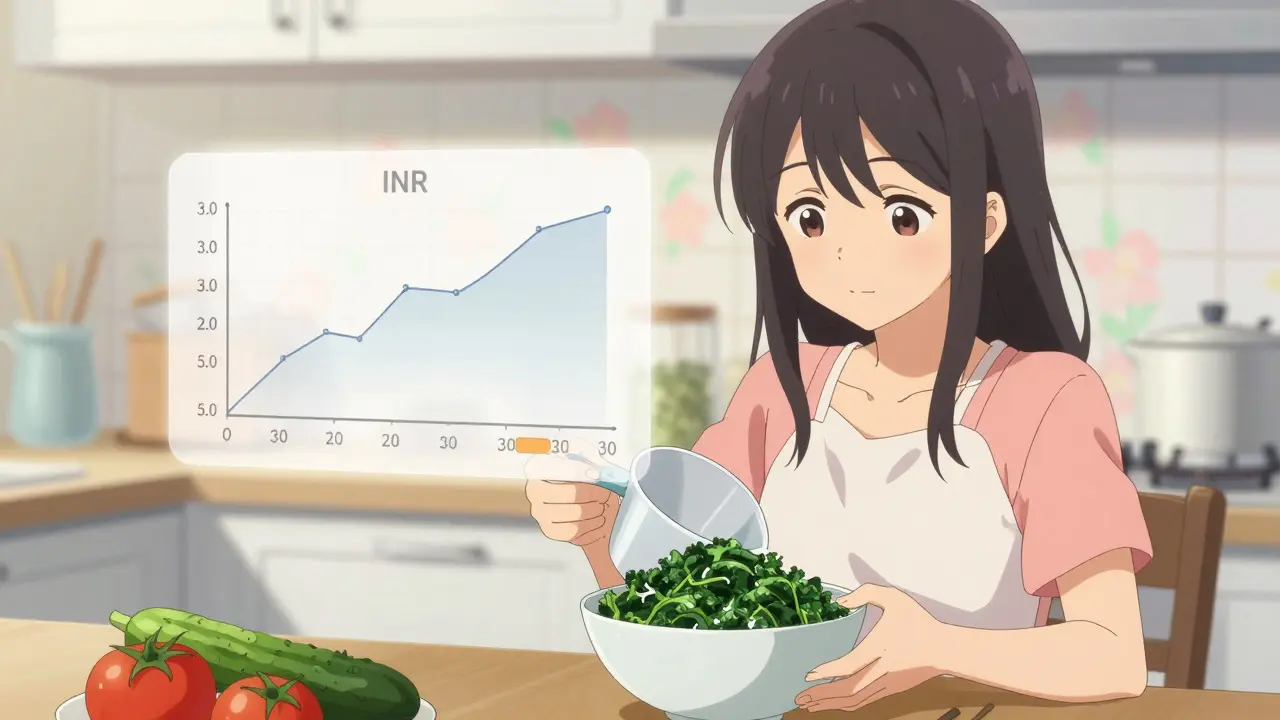
When you’re on warfarin, your doctor doesn’t want you to stop eating spinach, kale, or broccoli. That’s not a mistake. It’s science. For decades, people were told to avoid green leafy vegetables because they’re full of vitamin K-and vitamin K fights warfarin. But here’s the truth: warfarin doesn’t work better when you starve yourself of greens. It works better when you eat the same amount every day.
Why Vitamin K Matters with Warfarin
Warfarin, sold under brand names like Coumadin and Jantoven, is a blood thinner used to prevent clots in people with atrial fibrillation, artificial heart valves, or a history of deep vein thrombosis. It doesn’t dissolve clots. It stops new ones from forming by blocking vitamin K’s role in clotting factor production. Vitamin K is not the enemy. It’s essential. Your body needs it to make proteins that help your blood clot normally. Without it, you’d bleed uncontrollably from a paper cut. Warfarin just turns down the volume on that system. But if you suddenly eat a whole bag of kale one day and then skip greens the next, you’re turning the volume up and down randomly. That’s what throws your INR off. Your INR (International Normalized Ratio) is the number your doctor checks every few weeks to see how thin your blood is. A normal INR for someone on warfarin is usually between 2.0 and 3.0. Go below 2.0? You’re at risk for a clot. Above 3.0? You’re at risk for bleeding-inside your brain, your stomach, your joints. And one of the biggest reasons INR swings? Changes in vitamin K intake.How Much Vitamin K Is in These Foods?
Not all leafy greens are created equal. Here’s what you’re actually working with:- Cooked spinach: 889 mcg per cup
- Cooked kale: 547 mcg per cup
- Cooked collard greens: 772 mcg per cup
- Cooked broccoli: 220 mcg per cup
- Cooked cabbage: 418 mcg per cup
- Raw lettuce (romaine): 48 mcg per cup
Consistency Is the Only Rule That Works
Forget avoiding. Start measuring. The American College of Chest Physicians, the Mayo Clinic, the NHS, and the University of Iowa Hospitals & Clinics all say the same thing: eat the same amount of vitamin K-rich foods every week. Not every day. Every week. A 2024 study from Universitas Padjadjaran in Indonesia looked at warfarin patients who ate exactly 100 grams of spinach daily. That’s about one large handful. Their INR stayed stable. No spikes. No crashes. The researchers concluded that consistent intake-even at high levels-is safe and effective. That’s the key. You don’t need to go cold turkey. You need to go steady. If you usually eat a cup of cooked kale on Monday and Thursday, keep doing that. If you swap kale for spinach, make sure it’s the same portion. Don’t go from one cup of kale to two cups of spinach. That’s a 200% increase in vitamin K. Your INR will drop fast-within 3 to 5 days.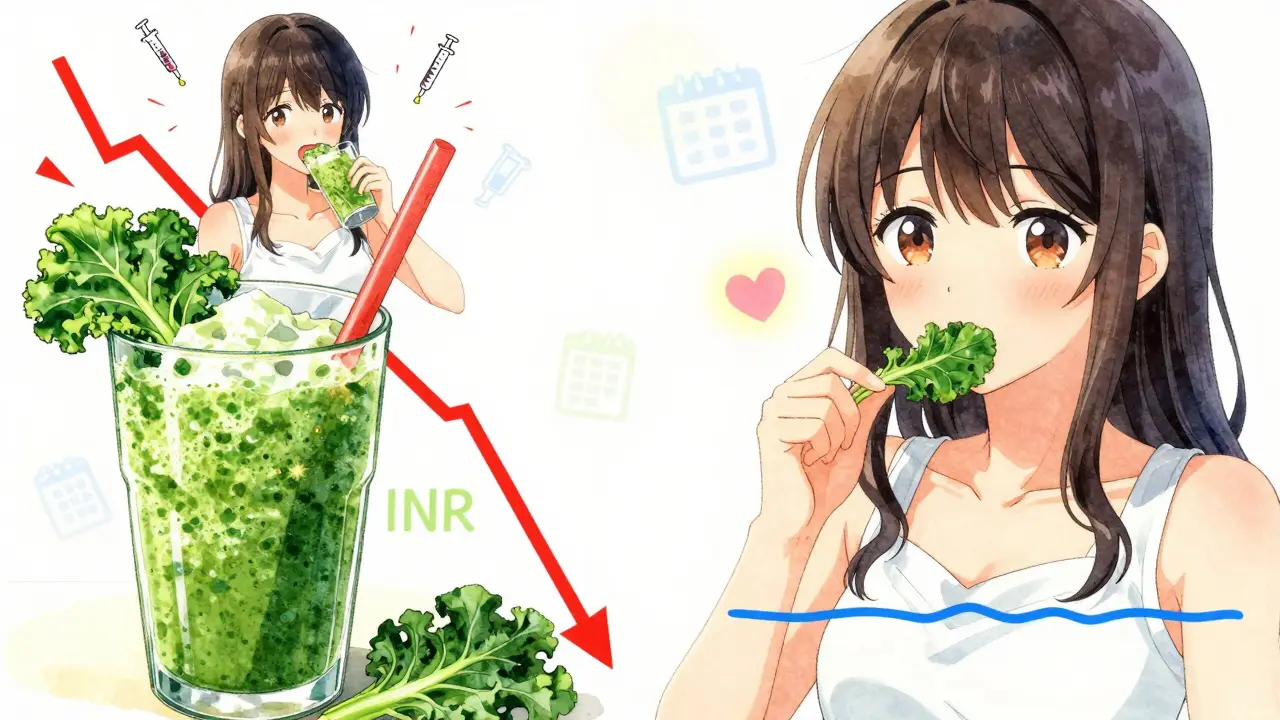
What Happens When You Flip the Switch?
Sudden changes in vitamin K intake don’t just cause minor INR shifts. They cause real danger. If you start eating more greens than usual-say, you go on a green smoothie kick-you’ll lower your INR. That means your blood clots faster. You’re at higher risk for a stroke or pulmonary embolism. If you suddenly stop eating greens-maybe you’re sick, or you’re trying to be “safe”-your INR will rise. Your blood won’t clot as easily. You could bleed internally without warning. That’s not theoretical. In 2021, 38% of all warfarin-related ER visits in the U.S. were linked to dietary changes. And it’s not just greens. Things like sudden stomach bugs, diarrhea, or fever can mess with how your body absorbs vitamin K. If you’ve been sick for a few days and then start eating normally again, your INR can swing. That’s why your doctor asks you to report any illness.What Can You Eat Without Worrying?
You don’t have to live on white rice and chicken. There are plenty of vegetables that are low in vitamin K and safe to eat freely:- Lettuce (iceberg or butter): ½ cup (80g)
- Carrots: 3 dessert spoons
- Cauliflower: 8 florets
- Courgettes (zucchini): ½ a large one
- Mushrooms: 3-4 dessert spoons
- Tomatoes: 1 medium
- Onions, peppers, cucumbers: any amount
What About Newer Blood Thinners?
Yes, there are alternatives. DOACs-like apixaban (Eliquis), rivaroxaban (Xarelto), and dabigatran (Pradaxa)-don’t interact with vitamin K. You can eat spinach without checking your INR. That’s why 68% of patients switched from warfarin to DOACs in one 2022 study cited in the Journal of Thrombosis and Haemostasis. But DOACs aren’t for everyone. If you have a mechanical heart valve-especially in the mitral position-DOACs are dangerous. They don’t work well enough. Warfarin is still the only option. Same if you have severe kidney disease (eGFR under 15). Or if you can’t afford $500 a month for a prescription. Warfarin costs $4-$10 a month. So for millions of people, warfarin is the only choice. And for them, consistency isn’t a suggestion. It’s survival.
What to Avoid Completely
Some things don’t just interfere with warfarin-they can cause serious harm:- St. John’s Wort: can drop your INR dangerously low
- Danshen (Chinese herb): increases bleeding risk
- Ginkgo Biloba: increases bleeding risk
- Cod liver oil: high in vitamin A and D, which can affect clotting
- Glucosamine: may raise INR
- Grapefruit juice: alters how your liver processes warfarin
Practical Tips for Daily Life
You don’t need to become a nutritionist. But you do need to be consistent. Here’s how:- Keep a food log. Note how much spinach, kale, or broccoli you eat each week.
- Use a measuring cup or kitchen scale for greens. A handful isn’t precise. A cup is.
- If you eat greens once a week, stick to that day. Don’t move it around.
- If you’re traveling, bring your usual greens or find a similar substitute.
- Don’t start or stop a green smoothie routine without telling your doctor.
- Get your INR checked every 2-4 weeks when stable. More often if your diet changes.
The Bottom Line
Green leafy vegetables aren’t the enemy of warfarin. Inconsistency is. You can eat kale. You can eat spinach. You can eat broccoli. Just make sure you eat the same amount, every week. That’s the only rule that matters. Your body needs vitamin K. Your blood needs stability. And warfarin works best when you give it both.Can I eat spinach if I’m on warfarin?
Yes, you can eat spinach while on warfarin-but only if you eat the same amount every day. A 2024 NIH study found that 100 grams (about one large handful) of spinach daily is safe and helps keep INR levels stable. The key isn’t avoiding it. It’s keeping portions consistent.
What happens if I suddenly eat more leafy greens?
Eating more vitamin K-rich foods like kale, spinach, or broccoli can lower your INR within 3-5 days. This means your blood clots more easily, increasing your risk of stroke or blood clots. Even one big salad can throw off your dose. Always tell your doctor if your diet changes.
Is it better to switch to a newer blood thinner like Eliquis?
For many people, yes. DOACs like Eliquis and Xarelto don’t interact with vitamin K, so you don’t need to track your greens. But they’re not right for everyone. If you have a mechanical heart valve, severe kidney disease, or can’t afford the $500-$600 monthly cost, warfarin is still the best option. Talk to your doctor about your options.
What vegetables are safe to eat freely on warfarin?
You can eat these without worrying about vitamin K: lettuce (½ cup), carrots (3 dessert spoons), cauliflower (8 florets), zucchini (½ large), mushrooms (3-4 dessert spoons), tomatoes, onions, peppers, and cucumbers. These have low vitamin K and won’t affect your INR.
Should I avoid all green vegetables on warfarin?
No. Avoiding green vegetables is outdated advice and can be dangerous. Cutting out vitamin K can cause your INR to rise too high, increasing your risk of dangerous bleeding. The modern standard is consistency-not avoidance. Eat your greens, but eat the same amount every week.
How often should I get my INR checked?
When your dose is stable, check every 2-4 weeks. If you change your diet, start a new medication, get sick, or travel, check weekly until your INR stabilizes again. Your doctor will adjust your schedule based on your history and consistency.
Can supplements interfere with warfarin?
Yes. St. John’s Wort, Ginkgo Biloba, Danshen, glucosamine, and cod liver oil can all affect how warfarin works. Even “natural” supplements can cause serious bleeding or clotting. Always check with your pharmacist before taking anything new.
Why does warfarin still exist if newer drugs are available?
Warfarin is cheaper-just $4-$10 a month-and still the only option for people with mechanical heart valves or severe kidney disease. It’s also reversible with vitamin K if bleeding happens. While DOACs are easier to manage, warfarin remains essential for specific cases and low-income patients.
Amy Insalaco
January 29, 2026 AT 23:02Look, I get that consistency is the buzzword here, but let’s be real-human beings are not lab rats. You’re telling me someone with a 9-to-5, two kids, and a spouse who thinks ‘kale’ is a type of yoga pose is going to measure their spinach in 100-gram increments? That’s not adherence, that’s performance art. The real issue isn’t vitamin K variability-it’s the healthcare system’s inability to design for actual human behavior. If your solution requires a kitchen scale and a spreadsheet, you’ve already lost 80% of your patients. And don’t even get me started on the $500/month DOACs. This isn’t medicine. It’s economic coercion dressed up as clinical wisdom.
Natasha Plebani
January 31, 2026 AT 10:47There’s an ontological paradox here: if warfarin’s efficacy hinges on the constancy of dietary intake, then the drug itself becomes a mirror of neoliberal discipline-the body as a system to be optimized, regulated, and quantified. Vitamin K isn’t the enemy; it’s the scapegoat for a medical paradigm that pathologizes natural variability. We’re not just managing INR levels-we’re enforcing a bio-political order where the ‘good patient’ is the one who eats the same amount of greens every week, like a clockwork organism. But what about the seasonal eater? The spontaneous cook? The person who eats kale because their grandma made it on Sundays? The system doesn’t accommodate narrative. It only demands compliance.
calanha nevin
January 31, 2026 AT 14:49Consistency is non-negotiable for warfarin safety. Eating the same amount of vitamin K every week reduces INR fluctuations by up to 70%. That’s not a suggestion-it’s a life-saving protocol. If you’re eating a cup of cooked spinach on Monday and Thursday, keep doing it. If you swap spinach for kale, match the portion. Don’t guess. Measure. Use a cup. Use a scale. Your INR doesn’t care about your feelings. It responds to micrograms. And if you’re worried about affordability, warfarin is $4 a month. DOACs aren’t for everyone. But consistency? That’s free. And it’s yours to control.
Lisa McCluskey
February 1, 2026 AT 09:31I’ve been on warfarin for 12 years. I eat a cup of cooked kale every Tuesday and Friday. That’s it. I don’t stress about it. I don’t track it. I just do it. My INR has been stable since 2018. I didn’t need an app. I didn’t need a dietitian. I just found a rhythm that worked. If you’re overwhelmed, start small. Pick one veggie. Stick to it. One day a week. Then two. Your body will thank you. And your doctor will too. You don’t have to be perfect. Just steady.
Russ Kelemen
February 2, 2026 AT 23:49Let me tell you something I’ve seen in clinics for 15 years: the people who survive on warfarin aren’t the ones who memorized vitamin K charts. They’re the ones who found a routine they could stick to. Maybe it’s a smoothie every morning. Maybe it’s broccoli with dinner on Tuesdays. Doesn’t matter what it is-just make it part of your life, not a chore. And if you’re thinking about switching to a DOAC? Talk to your doctor. But don’t assume it’s the easy way out. They’re not magic. They’re expensive. And they don’t work for everyone. Your consistency is your superpower. Own it.
Diksha Srivastava
February 3, 2026 AT 08:58So happy to see this post! I used to avoid greens because I was scared, but now I eat a little every day and my INR is perfect. You don’t need to be perfect, just consistent. Small steps, big results. You got this!
Sidhanth SY
February 4, 2026 AT 19:05Man I used to eat a whole bag of spinach on weekends and wonder why my INR went nuts. Then I started eating one cup every other day and boom-stable. No magic. Just dumb simple consistency. Also, I don’t even measure anymore. I just use a coffee mug. Works fine. Don’t overthink it.
Adarsh Uttral
February 5, 2026 AT 14:17wait so i can eat spinach?? i thought i had to avoid it like the plague lmao