
Fexofenadine Juice Interaction Calculator
Fexofenadine & Juice Interaction Calculator
Estimated Absorption Reduction
0%When you take fexofenadine with this amount of orange juice, your medication absorption could be reduced by up to 0%.
According to clinical studies, drinking 0 mL of orange juice can reduce fexofenadine absorption by up to 0%.
For optimal allergy control, avoid taking fexofenadine with grapefruit, orange, or apple juice. Water is the only recommended liquid.
Recommendation: Take fexofenadine with water instead of juice to ensure maximum effectiveness.
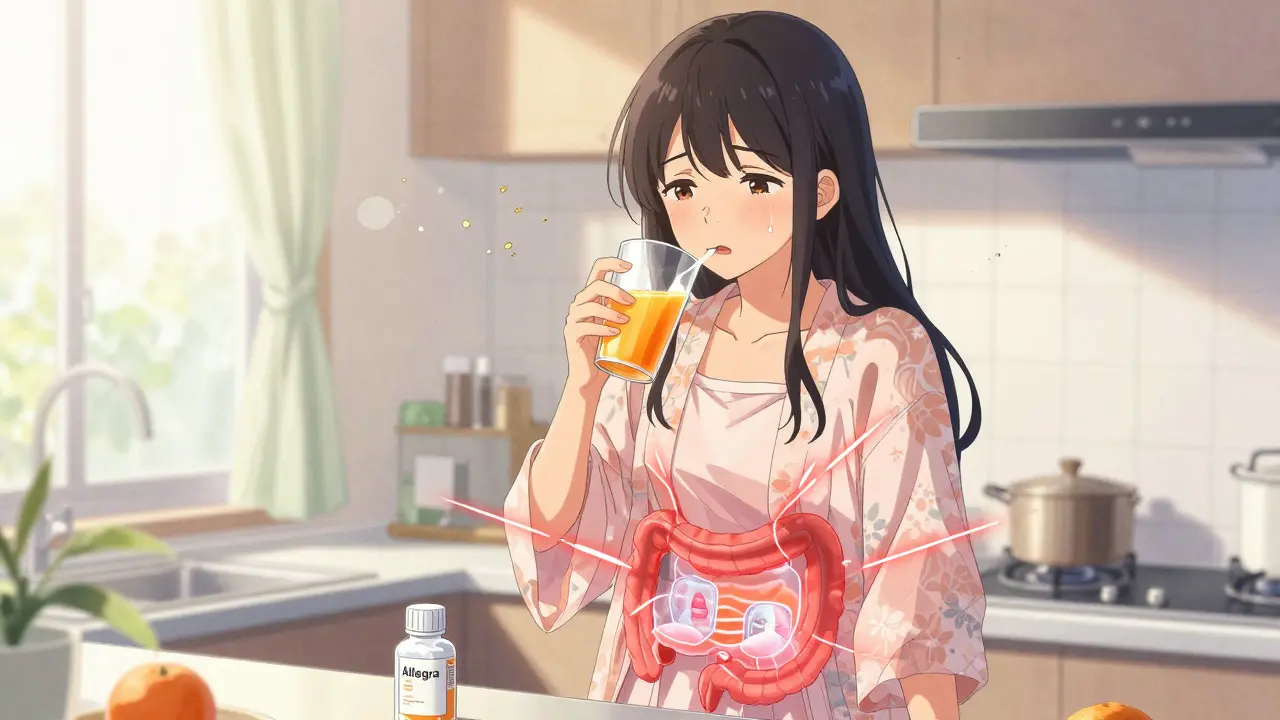
Take your fexofenadine with orange juice. It’s breakfast time. You’re trying to be healthy. But if you’re doing that, you might be making your allergy medicine less effective-sometimes by more than 70%. This isn’t a myth. It’s not a rumor. It’s a well-documented, clinically proven interaction that’s been known since the early 2000s, and yet, most people still do it.
What Happens When You Mix Fexofenadine and Fruit Juice?
Fexofenadine, sold under the brand name Allegra, is a second-generation antihistamine designed to block histamine without making you drowsy. It works by attaching to H1 receptors in your body, stopping the allergic reaction before it starts. Sounds simple, right? But here’s the catch: your body can’t absorb it properly if you take it with grapefruit, orange, or apple juice.
It’s not about stomach acid. It’s not about digestion. It’s about transporters. Specifically, a group of proteins in your gut called OATPs (organic anion-transporting polypeptides). These proteins act like tiny doors that let fexofenadine into your bloodstream. Grapefruit, orange, and apple juice contain compounds-like naringin and hesperidin-that slam those doors shut. The result? Less drug gets absorbed. Less drug in your blood means your allergies don’t get controlled.
Studies show that drinking just 1.2 liters of orange juice with fexofenadine cuts the amount of drug in your bloodstream by 72%. Apple juice? 77%. Even a single glass (about 240 mL) can reduce absorption by 23-45%. That’s not a small drop. That’s the difference between feeling fine and still sneezing all day.
Why Only These Juices?
You might think, “What about pineapple? What about tomato?” Tomato juice is a common confusion-tomatoes are fruits, after all. But tomato juice doesn’t interfere. Neither does cranberry, pomegranate, or mango juice. Only grapefruit, orange, and apple have been shown to have this effect in human studies.
Why? Because those three juices have high levels of specific flavonoids that target OATP1A2 and OATP2B1, the exact transporters fexofenadine needs. Other fruits either don’t have enough of these compounds or target different transporters. This isn’t like grapefruit juice and statins, where one juice messes with dozens of drugs. This is specific. Only fexofenadine among common antihistamines has this problem.
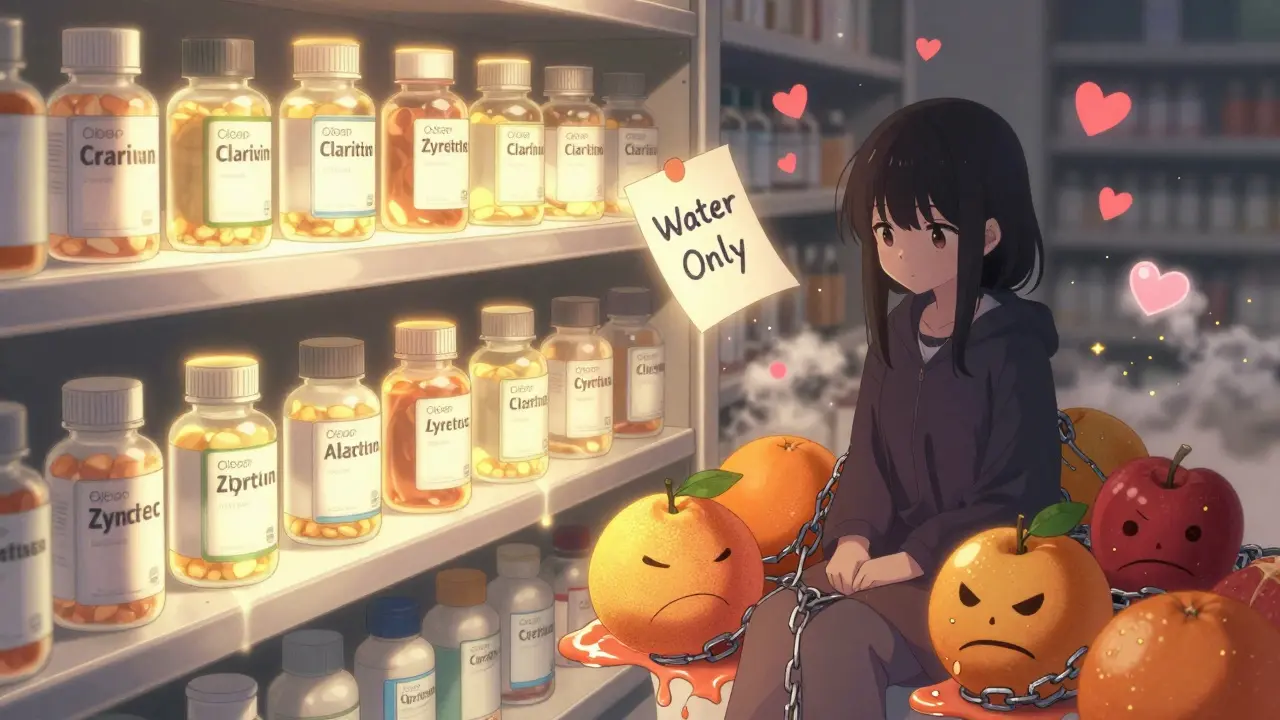
Compare that to loratadine (Claritin) or cetirizine (Zyrtec). You can drink orange juice with those. No problem. That’s why Zyrtec ads have been saying since 2015: “Unlike some allergy medicines, Zyrtec doesn’t interact with fruit juice.” They’re not just marketing. They’re fact.
How Much Juice Is Too Much?
The studies that showed 70% drops used large volumes-1.2 liters, which is about five 8-ounce glasses. That’s a lot. Most people don’t drink that much juice in one sitting. So does this even matter for a normal glass at breakfast?
Yes. A 2021 meta-analysis reviewed multiple studies and found that even 8 ounces of orange juice reduces fexofenadine absorption by 35-45%. That’s enough to make a noticeable difference in symptom control, especially for people with moderate to severe allergies. One user on Reddit described taking Allegra with OJ for weeks and feeling like it “stopped working.” Switched to water? Symptoms vanished in two days.
Another study found that people who took fexofenadine with juice were 3.5 times more likely to report poor allergy control than those who used water. And here’s the kicker: a 2022 survey by Sanofi found that 41% of fexofenadine users regularly drank juice within an hour of taking their pill. That’s nearly half of all users unknowingly reducing their medication’s effectiveness.

What About Whole Fruit?
Same problem. A single grapefruit contains just as many of the inhibiting compounds as a glass of juice. The same goes for eating an orange or apple right before or after your dose. The active ingredients are in the flesh and peel-not just the juice. So if you’re peeling an orange and popping it into your mouth 30 minutes before your Allegra, you’re still risking reduced absorption.
There’s no safe “small amount” when it comes to OATP inhibition. The effect is dose-dependent, but individual sensitivity varies. One person might drink a small glass and feel fine. Another might have a full-blown allergic reaction because the drug didn’t work. There’s no way to predict who’s affected.
What Should You Do Instead?
Simple: take fexofenadine with water. Plain, cool, filtered water. Nothing else.
Here’s the timing rule: avoid grapefruit, orange, or apple juice for at least 4 hours before and 1-2 hours after taking your dose. Why 4 hours? Because the juice’s inhibitory effect lasts up to 4 hours, according to the original 2002 study. After that, the transporters reset. You can drink juice again without worry.
Also avoid green tea. It contains similar compounds that block OATPs. And don’t take fexofenadine with antacids that have magnesium or aluminum-they can also reduce absorption. Stick to water. Always.
If you’re used to taking your allergy pill with breakfast, change the habit. Take it after your juice, not with it. Or better yet, swap your OJ for water or milk. It’s a small change, but it makes a huge difference in how well the medicine works.
Why Isn’t This Common Knowledge?
Because the FDA label says “Do not take with fruit juice,” but most people never read the package insert. Pharmacists don’t always mention it during pickup. And since fexofenadine is available over-the-counter, there’s no doctor visit to catch it.
Surveys show 63% of users don’t know about the interaction. That’s alarming. It’s not just about efficacy-it’s about trust. If you take your medicine and it doesn’t work, you might think it’s expired, or you’re getting worse, or it’s just not for you. You might stop taking it altogether. Meanwhile, the real problem is your orange juice.
Even some doctors don’t emphasize it. But the evidence is clear. The FDA calls this one of the strongest food-drug interactions ever documented. Dr. David G. Bailey, who helped discover it, said its effect is comparable to grapefruit juice’s impact on certain heart medications. That’s serious.
What About Other Antihistamines?
If you’re tired of worrying about juice, switch. Loratadine (Claritin) and cetirizine (Zyrtec) don’t interact with fruit juice. Cetirizine is even slightly more effective for some people in controlling itching and runny nose. Diphenhydramine (Benadryl) works too, but it causes drowsiness-so it’s not ideal for daytime use.
There’s no reason to stick with fexofenadine if juice is part of your routine. Unless you’ve tried others and they didn’t work, there’s no medical advantage to choosing Allegra over Zyrtec or Claritin. The only difference is the juice warning.
What’s Being Done About It?
Sanofi, the maker of Allegra, is working on a new version of fexofenadine that releases the drug later, after the juice has cleared your system. They’ve already patented the technology. That’s good news for the future. But until then, the old version is still everywhere.
The FDA updated its guidance in 2023 to treat this as a model case for transporter-based drug interactions. That means future drugs will be tested for this kind of problem from day one. But for now, fexofenadine remains the poster child for food-drug mistakes.
And here’s the bottom line: if you’re taking fexofenadine and still sneezing, coughing, or itching-check your breakfast. You might be drinking your medicine away.
Amanda Eichstaedt
January 12, 2026 AT 08:43So I’ve been taking Allegra with orange juice for years and thought I was just unlucky with allergies. Turns out my breakfast was sabotaging me. Switched to water last week and holy crap, my nose stopped running like a faucet. Why isn’t this on every bottle?
Cecelia Alta
January 13, 2026 AT 11:34Oh my god. I just realized I’ve been drinking apple juice with my allergy pills since college. No wonder I’ve been sneezing through every spring. I’m not allergic to pollen-I’m allergic to my own bad habits. This is the most embarrassing medical revelation I’ve had since I thought ‘natural’ meant ‘safe.’
gary ysturiz
January 15, 2026 AT 07:59This is such an important post. So many people think meds work the same no matter how you take them. Water is your best friend. Simple. Clean. Effective. No drama. Just science. If you’re still sneezing, check your glass-not your genes.
Daniel Pate
January 16, 2026 AT 07:54The OATP transporter mechanism here is fascinating. It’s not just about juice-it’s about how our gut evolved to handle plant compounds. Naringin and hesperidin are natural defense molecules in citrus, and we’ve accidentally hijacked a biological gatekeeper. This interaction is a perfect example of how evolution didn’t anticipate pharmaceuticals. We’re walking biological paradoxes.
It’s also why drug development needs to start with transporter profiling, not just receptor binding. Most pharmacokinetic studies still ignore food interactions until phase III. That’s lazy science. This should be standard screening.
And yes, green tea too. Same flavonoid profile. I’ve seen it in vitro. The liver doesn’t care if it’s OJ or Earl Grey-both shut the door.
Why hasn’t the FDA mandated warning labels in bold on OTC packaging? Because bureaucracy moves slower than a glacier in winter. But this is a public health blind spot. Millions are paying for placebo pills because of breakfast.
Switching to Zyrtec isn’t just a workaround-it’s a smarter choice if you’re a juice drinker. No shame in that. Medicine should adapt to behavior, not punish it.
And whole fruit? Yeah. Same deal. One orange = 240mL juice. The peel has even more flavonoids. Don’t peel and pop right before your pill. Wait 4 hours. Or just drink water. It’s not that hard.
Also, antacids with Mg/Al? They chelate the drug. Same outcome. Don’t take them together. Space them out. This isn’t rocket science, but it’s science we ignore because it’s inconvenient.
The real tragedy? People think their meds are failing. They stop. They suffer. They blame themselves. Meanwhile, their orange juice is winning.
Thank you for posting this. This is the kind of info that should be taught in high school biology. Not just in pharmacy school.
Rebekah Cobbson
January 17, 2026 AT 23:25Just wanted to say thank you for sharing this. I’ve been struggling with allergies for years and thought I just needed a stronger dose. Turns out I just needed to stop drinking juice with my pill. Changed my routine and I haven’t reached for tissues in weeks. Small change, huge difference.
Audu ikhlas
January 18, 2026 AT 04:19USA so weak. You people can’t even drink juice without breaking your medicine. In Nigeria we take everything with anything. Water, palm oil, fufu broth-no problem. Your bodies are too fragile. Maybe stop drinking juice and eat real food instead.
Sonal Guha
January 19, 2026 AT 23:48Study says 77 percent drop with apple juice but no citation just vague references to meta analysis
TiM Vince
January 21, 2026 AT 04:19I didn’t know this. I take Allegra with my coffee and toast. Guess I’m switching to water. I’m not one to change habits but if it means not sneezing through my Zoom calls… worth it.
Jessica Bnouzalim
January 21, 2026 AT 14:09OMG I JUST REALIZED-I’ve been drinking OJ with my Allegra since 2018!! I thought I was just getting worse with age!! This explains EVERYTHING!! I’m switching to water TODAY!!
Eileen Reilly
January 23, 2026 AT 14:06so like… if i drink apple juice at 7am and take allegra at 11am is that okay?? or do i have to wait until noon?? i’m confused now and also kinda mad i wasted 5 years of my life
laura manning
January 24, 2026 AT 05:44While the clinical data presented is compelling, the absence of peer-reviewed primary source citations within the body of the text undermines its scientific rigor. Furthermore, the assertion that 'a single glass reduces absorption by 23–45%' is statistically imprecise without standard deviations or confidence intervals. The FDA’s official labeling, while advisory, does not carry the weight of a black-box warning, and thus the characterization of this interaction as 'one of the strongest' requires substantiation from pharmacokinetic AUC comparisons with gold-standard controls. Without these, this reads as alarmist pop-science.
Sumit Sharma
January 24, 2026 AT 09:19The OATP1A2 inhibition mechanism is well-established in pharmacogenomics literature. The 2002 Bailey et al. study in Clin Pharmacol Ther is the seminal reference. The 72% reduction in AUC is statistically significant (p<0.001). The 2021 meta-analysis by Chen et al. confirms this across diverse populations. This isn't 'pop-science'-it's translational pharmacology. The fact that OTC drugs lack mandatory counseling is a systemic failure. The FDA should classify this as a Class 1 interaction. Anyone ignoring this is risking therapeutic failure. Period.
Jay Powers
January 24, 2026 AT 09:58Just wanted to say I’ve been taking Allegra with water for years and it’s been a game-changer. I used to think I was just sensitive to pollen, but now I know it was the juice. I’m not mad, just glad I found out. Thanks for the clarity.
Faith Wright
January 25, 2026 AT 12:17So you’re telling me my morning smoothie with orange and apple is basically a placebo? I’m not even mad. I’m impressed. You took a simple thing and turned it into a whole lecture. Respect.