

Most people assume that if a drug gets approved, it’s been thoroughly tested for safety. But the truth is, some of the most serious risks only show up after thousands or even millions of people start taking it. That’s where drug safety signals come in - the early warnings that something might be wrong, hidden in mountains of data no one saw during clinical trials.
What Exactly Is a Drug Safety Signal?
A drug safety signal isn’t a confirmed danger. It’s a pattern - a hint - that a medicine might be linked to a new or unexpected side effect. The Council for International Organizations of Medical Sciences (CIOMS) defines it as information suggesting a possible causal link between a drug and an adverse event that’s serious enough to warrant further investigation. Think of it like a smoke alarm going off. It doesn’t mean there’s a fire, but you better check it out. These signals don’t come from lab tests or controlled experiments. They come from real-world use. A doctor reports a patient had a rare stroke after starting a new blood pressure pill. A patient files an online form saying they developed severe skin rashes after taking a common antidepressant. These scattered reports, when analyzed together, can reveal a pattern. That’s the signal.Why Don’t Clinical Trials Catch These Risks?
Clinical trials are designed to prove a drug works, not to find every possible side effect. They typically involve 1,000 to 5,000 people, often healthy volunteers or those with one specific condition. They’re short - usually months, sometimes a year or two. And they exclude people with multiple health problems, older adults, pregnant women, or those taking other medications. That’s a problem. Real patients aren’t like that. A 72-year-old with diabetes, kidney disease, and high blood pressure might be on six different pills. One of them is the new drug. What happens when all those drugs interact? Clinical trials rarely see that. A 2000 study by Temple and Ellenberg showed that rare side effects - those affecting fewer than 1 in 1,000 people - almost never show up in trials. Yet, when a drug hits the market and 500,000 people take it, even a 1 in 5,000 risk becomes 100 cases. That’s how signals emerge: scale, diversity, and time.Where Do These Signals Come From?
There are two main sources: spontaneous reports and data from clinical trials. Spontaneous reports are the backbone of pharmacovigilance. These are voluntary reports from doctors, pharmacists, patients, or family members. The FDA’s FAERS database holds over 30 million of them. The EMA’s EudraVigilance collects over 2.5 million per year. Most are messy - incomplete, vague, unverified. But they’re the only window into what happens outside the lab. The second source is the clinical trial data itself. Even after approval, researchers keep digging into trial results. Sometimes, a side effect that looked like a fluke in a small group turns out to be real when you re-analyze the numbers across all trial sites. Other sources include epidemiological studies (tracking large populations over time), scientific literature, and patient registries. The most powerful signals come when multiple sources point to the same problem - like the link between rosiglitazone and heart attacks, which showed up in spontaneous reports, clinical trials, and population studies all at once.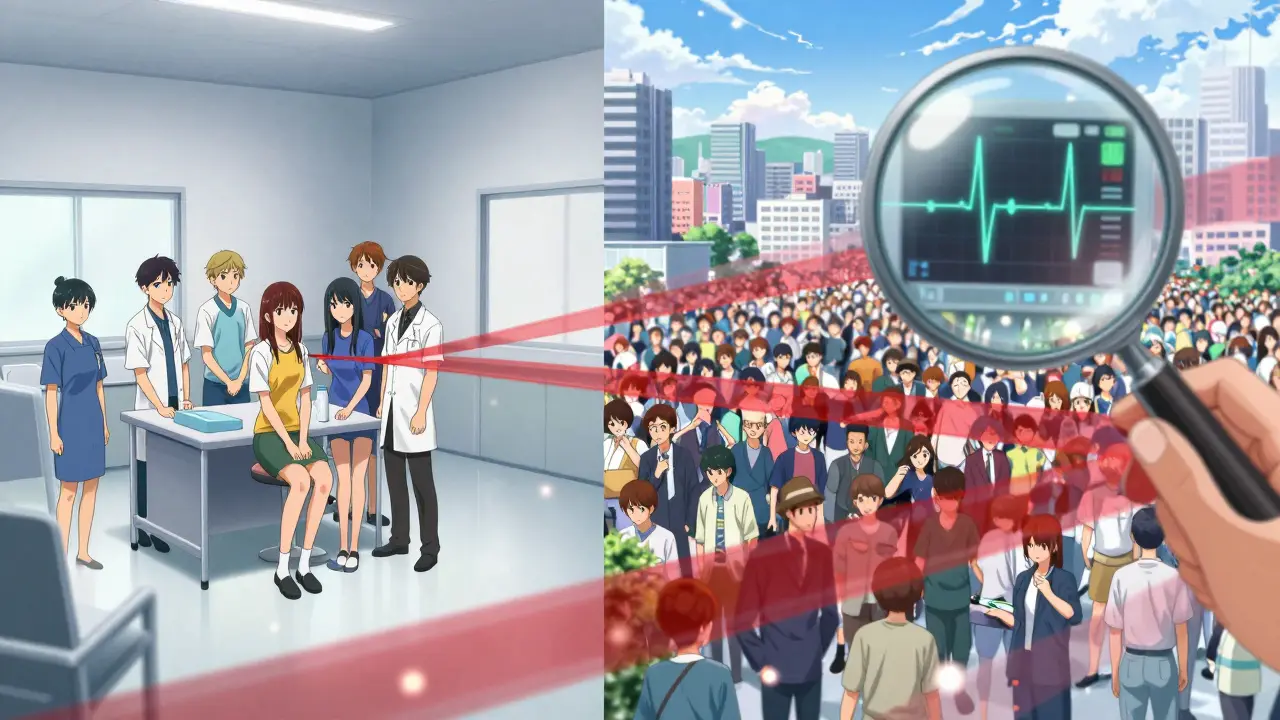
How Do Experts Find These Signals?
Finding a signal in millions of reports is like finding a needle in a haystack - and the haystack is on fire. That’s why regulators use statistical tools. One common method is disproportionality analysis. It compares how often a side effect is reported with a specific drug versus how often it’s reported with other drugs. If a rare kidney injury shows up 10 times more often with Drug X than with any other, that’s a red flag. The system looks for a Reporting Odds Ratio (ROR) above 2.0 and at least three reported cases. Other methods include Bayesian Confidence Propagation Neural Networks (BCPNN) and Proportional Reporting Ratios (PRR). But here’s the catch: 60 to 80% of these statistical signals turn out to be false alarms. A spike in headaches after a new migraine drug? Probably just people reporting common side effects. A sudden uptick in liver damage? That’s worth a closer look. That’s why experts don’t rely on numbers alone. They look at the story behind the report. Did the patient improve after stopping the drug (dechallenge)? Did symptoms return when they restarted it (rechallenge)? Is there a biological reason why the drug could cause this? That’s clinical judgment - and it’s just as important as the math.When Do Signals Lead to Real Changes?
Not every signal becomes a warning label. A 2018 analysis of 117 signals found four things that made a difference:- Multiple sources confirming it - if three different databases show the same pattern, the chance of a real risk jumps 4.3 times.
- How serious the side effect is - 87% of serious events led to label changes. Non-serious ones? Only 32%.
- Plausibility - does the drug’s mechanism make sense as a cause? If it damages liver cells, and people start getting liver failure, that’s plausible.
- How new the drug is - drugs under five years old are nearly twice as likely to get label updates than older ones.

What Goes Wrong in Signal Detection?
The system is powerful, but it’s far from perfect. One big issue is data quality. A 2022 survey of 142 safety officers found 68% struggled with incomplete or inaccurate reports. Many don’t include the patient’s full medical history, lab results, or whether other drugs were involved. Another problem is reporting bias. Serious events are reported 3.2 times more often than mild ones. So if a drug causes mild nausea in 10% of users but only one person reports a rare heart rhythm issue, the system will overfocus on the heart issue - even if it’s not common. Then there’s latency. Some side effects take years to appear. Bisphosphonates, used for osteoporosis, were linked to jaw bone death - osteonecrosis - only after seven years of use. By then, hundreds of thousands had taken them. And false positives waste resources. A 2017 study by Dr. Sean Hennessy found that many statistical signals are just noise - distracting teams from real threats. That’s why the field is moving toward AI. The EMA’s 2022 update to EudraVigilance cut signal detection time from 14 days to 48 hours using machine learning. The FDA’s Sentinel Initiative now pulls data from 300 million patients’ electronic health records, spotting patterns in near real-time.The Future: Smarter, Faster, More Connected
The future of drug safety is integration. Instead of siloed databases, regulators are connecting spontaneous reports, EHRs, pharmacy records, and even wearable data. By 2027, 65% of high-priority signals are expected to come from these combined systems - up from just 28% in 2022. The ICH’s new M10 guideline, set for adoption in 2024, will standardize how lab results like liver enzymes are reported, making it easier to spot drug-induced liver injury. And the EU now requires every new drug application to include a detailed signal detection plan - no more guesswork. But the biggest challenge remains: aging populations. Since 2000, prescription drug use among the elderly has more than quadrupled. People are taking five, six, seven medications. Drug interactions are complex, and current systems aren’t built for that. As Dr. Jerry Gurwitz warned, our safety nets were designed for simpler times.What Patients and Doctors Need to Know
If you’re taking a new medication, understand that safety monitoring doesn’t stop at approval. Your doctor should be aware of recent safety updates. If you notice something unusual - a new rash, unexplained fatigue, sudden dizziness - report it. Your report might be the first clue in a larger pattern. Doctors, too, need to stay alert. Don’t dismiss symptoms as “just aging” or “probably unrelated.” Document everything. The more complete the report, the better the chance a signal will be caught. Drug safety isn’t a one-time check. It’s a continuous conversation between patients, providers, and regulators - fueled by data, guided by science, and driven by the simple goal: don’t let a medicine that helps one person hurt another.What’s the difference between a drug safety signal and a confirmed side effect?
A safety signal is a pattern suggesting a possible link between a drug and an adverse event - it’s a warning that needs investigation. A confirmed side effect is one that’s been proven through multiple studies, with enough evidence to show the drug likely caused it. Signals are hypotheses. Confirmed side effects are facts.
Why are older drugs less likely to get safety updates?
Older drugs have been used by millions over decades, so most common or serious side effects are already known and documented. Newer drugs have less real-world data, so unexpected risks are more likely to emerge. Also, regulators prioritize updates for newer medications because the risk-benefit balance is still being assessed.
Can a drug be pulled from the market because of a safety signal?
Yes, but it’s rare. Most signals lead to label changes - stronger warnings, new contraindications, or restrictions. Withdrawal usually happens only if the risk outweighs the benefit and no safer alternatives exist. Examples include rosiglitazone (restricted) and cerivastatin (withdrawn) after signals linked them to severe muscle damage.
How long does it take to investigate a safety signal?
It varies. Simple signals with clear patterns can be assessed in weeks. Complex ones - especially those involving rare events or multiple interacting drugs - can take 3 to 6 months or longer. The use of AI and shared databases has reduced this time by up to 22% since 2020.
Are patient reports really useful in detecting safety signals?
Absolutely. While professional reports are more detailed, patient reports often capture symptoms doctors miss - like fatigue, brain fog, or mood changes. They also provide crucial context like timing: “I started the pill on Monday and got the rash by Wednesday.” That kind of detail helps establish causality.
Jane Lucas
December 27, 2025 AT 15:57Caitlin Foster
December 28, 2025 AT 13:16Liz MENDOZA
December 30, 2025 AT 01:56Miriam Piro
December 30, 2025 AT 16:42Todd Scott
December 31, 2025 AT 16:52Andrew Gurung
December 31, 2025 AT 22:44Paula Alencar
January 1, 2026 AT 03:22Nikki Thames
January 1, 2026 AT 15:14Chris Garcia
January 2, 2026 AT 03:31Will Neitzer
January 2, 2026 AT 13:06Janice Holmes
January 3, 2026 AT 04:35James Bowers
January 3, 2026 AT 19:48