
Combination Drug Suitability Checker
Assess Your Combination Drug Suitability
Your Combination Drug Suitability Assessment
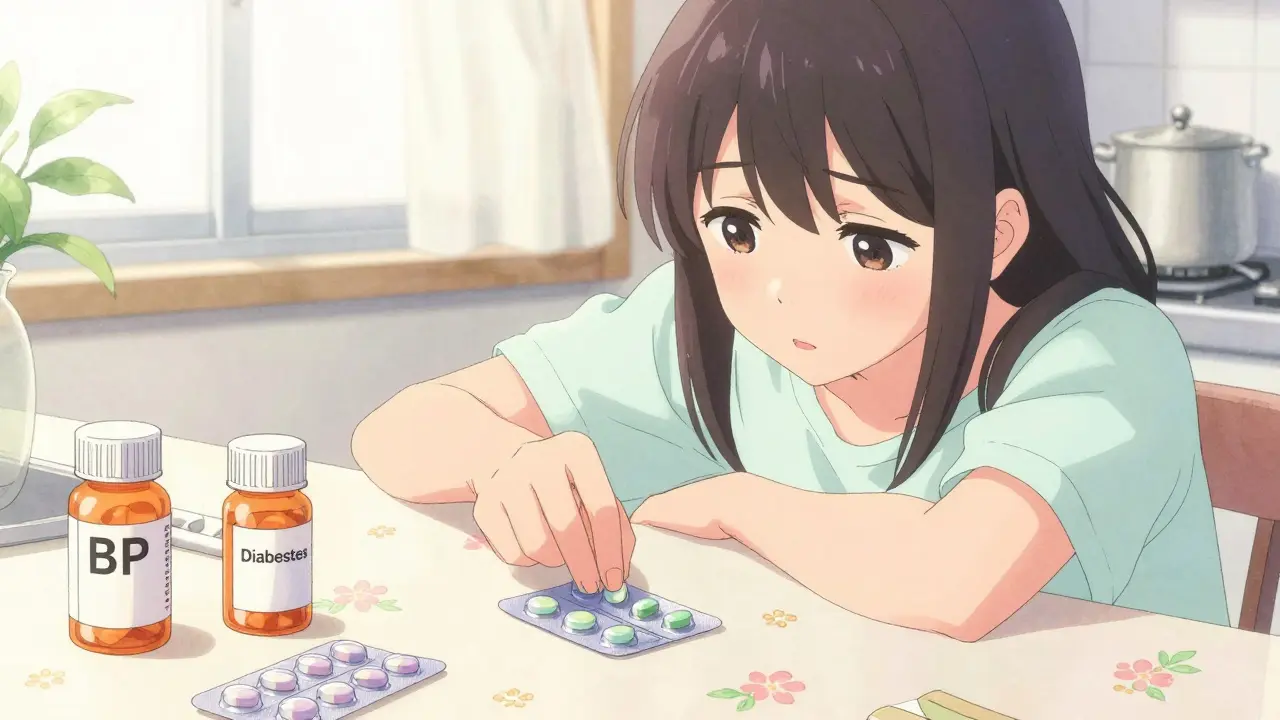
Most people taking multiple medications know the drill: morning pill, afternoon pill, bedtime pill. It’s not just annoying-it’s a real barrier to sticking with treatment. That’s where combination drugs come in. They bundle two or more active ingredients into a single tablet or capsule, cutting down the number of pills you swallow. For many, it’s a game-changer. But behind the convenience lies a hidden cost: increased risk of side effects, inflexible dosing, and even dangerous interactions. So, are these combo pills helping you-or hiding risks you didn’t know you were taking?
Why Combination Drugs Exist
Combination drugs aren’t new. Ancient medicine systems like Traditional Chinese Medicine used multi-herb formulas for centuries. But modern fixed-dose combinations (FDCs) became a medical tool in the 1970s, with drugs like sulfamethoxazole and trimethoprim used together to fight bacterial infections. The idea was simple: if two drugs work better together, why make patients take two separate pills? The benefits are clear. A study published in 2019 found that patients on combination drugs for high blood pressure were 20% more likely to stick with their treatment than those taking the same drugs separately. Less pill burden means fewer missed doses. For people with chronic conditions like diabetes, heart disease, or tuberculosis, that matters. The World Health Organization includes 18 FDCs in its Essential Medicines List-proof that, when done right, these combinations save lives. In cancer treatment, combination therapies attack tumors from multiple angles at once. This reduces the chance of resistance developing. For Parkinson’s disease, levodopa combined with carbidopa helps more of the drug reach the brain, easing tremors with fewer side effects. In hypertension, low-dose combinations of ACE inhibitors and diuretics have become first-line treatment because they control blood pressure more effectively than single drugs alone.When Convenience Becomes a Problem
But here’s the catch: once you take a combo pill, you’re locked in. If your doctor needs to adjust the dose of just one ingredient-say, lowering the diuretic because you’re getting too dizzy-you can’t. You have to switch to separate pills or find another combo that matches your new needs. That’s not always possible. Worse, if one component causes a bad reaction, you lose the whole treatment. A patient with tuberculosis might develop a rash from one drug in the combo. Even if the other drugs are working perfectly, they can’t prescribe the combo anymore. The patient has to go back to managing three separate pills, increasing the chance they’ll stop treatment entirely. There’s also the risk of hidden interactions. When two drugs are combined, their effects aren’t always predictable. One might slow down how the other is broken down in the liver, causing toxic buildup. Or one might cancel out the other’s benefit. The FDA requires manufacturers to prove the combo is safe and effective as a unit-but not every combo on the market meets that standard.
The Global Patchwork of Regulation
In the U.S., the FDA treats combination drugs as new entities. Even if both ingredients have been approved separately, the combo must go through full testing. This means most FDCs sold here are backed by solid data. But that’s not true everywhere. In India, over 3,000 FDCs are on the market-nearly half of them never received proper regulatory review. The Central Drugs Standard Control Organization (CDSCO) has banned dozens of these irrational combinations over the past five years. Some contained antibiotics paired with painkillers with no proven benefit. Others mixed drugs with overlapping side effects, raising the risk of liver damage or kidney failure. The World Health Organization warns that unregulated antibiotic FDCs are fueling antimicrobial resistance. When patients take a combo pill with two antibiotics but only need one, the extra drug exposes bacteria to low doses-perfect for training them to survive. This isn’t just a problem in India. Similar issues have been reported in parts of Southeast Asia and Latin America.Combination Drugs vs. Compounded Medications
Not all multi-drug treatments are the same. Compounded medications are custom-made by pharmacists for individual patients. Maybe you can’t swallow pills, so your pharmacist makes a topical cream with amitriptyline, gabapentin, and ketamine for nerve pain. Or you’re allergic to a filler in a brand-name drug, so they remove it. Unlike FDCs, compounded drugs aren’t pre-approved by the FDA. That means there’s no guarantee of strength, purity, or safety. But they offer flexibility FDCs can’t match. If you need a dose of 12.5 mg of drug A and 50 mg of drug B-neither of which comes in that ratio-you can’t find an FDC. But a compounding pharmacy can make it. The trade-off? FDCs are standardized, tested, and reliable. Compounded drugs are tailored, but risky if not made by a trusted pharmacy.
Roshan Joy
January 10, 2026 AT 20:29Man, I’ve been on a combo pill for TB for 2 years now. It’s a lifesaver-no more juggling 5 different pills every morning. But yeah, when I got that rash? Total nightmare. Had to go back to separate tabs. Felt like starting over. 😅
Adewumi Gbotemi
January 11, 2026 AT 23:45This is real talk. In Nigeria, some pharmacies sell combo pills like candy. One guy I know took a combo with antibiotics and painkiller for a cold-and got liver issues. No one checked if it was legal. Scary stuff.
Michael Patterson
January 12, 2026 AT 09:23Look, I’m not a doctor but I read a lot of med journals and let me tell you-this whole FDC thing is a pharma scam wrapped in convenience. They don’t care about your liver or your kidney function, they care about patent extensions and profit margins. And don’t even get me started on the FDA’s loopholes. I mean, come on. You think they’re really protecting you? LOL. They’re protecting Big Pharma’s bottom line. I’ve seen patients on combo pills for HTN who end up in the ER because one component was too strong and they couldn’t adjust it. It’s not medicine-it’s corporate roulette.
Matthew Miller
January 13, 2026 AT 18:57Who the hell is still buying these combo pills without asking for the clinical trial data? If your doctor prescribes something you’ve never heard of, you’re either lazy or gullible. And if you’re in India and taking some unregulated garbage with two antibiotics and a NSAID? Congrats, you’re helping create superbugs. This isn’t healthcare-it’s negligence with a pill bottle on it.
Madhav Malhotra
January 14, 2026 AT 06:00As an Indian, I’ve seen both sides. My grandma took a combo for TB in a village clinic-it saved her life. But I also saw a cousin get hospitalized because of a combo with paracetamol and an antibiotic that shouldn’t have been together. We need better education, not just bans. Maybe community pharmacists should be trained to flag unsafe combos? 🙏
Priya Patel
January 14, 2026 AT 16:07I switched to a combo for my BP last year and honestly? My life changed. No more pill organizer chaos. But then I got dizzy and had to go back to singles. Felt like my body betrayed me. Still, I’m glad I tried it. Maybe one day they’ll make combos that can be adjusted… like LEGO pills? 😄
Jason Shriner
January 15, 2026 AT 17:32Oh wow, a whole article about combo drugs and no one mentioned the real villain: the pharmacy tech who just grabs the pre-bundled box because it’s faster than counting out 4 separate pills. Convenience isn’t medicine-it’s efficiency porn for overworked clinics. And we all pay for it with side effects.
Alfred Schmidt
January 17, 2026 AT 08:53STOP. JUST STOP. People are dying because of these combo pills, and you’re all acting like it’s a lifestyle hack?! I had a friend on a combo for HIV who got pancreatitis because one ingredient interacted with his statin-no one told him. He lost his job, his insurance, and his dignity. This isn’t ‘convenient’-it’s a ticking time bomb wrapped in a blister pack. Someone needs to sue these companies. Someone needs to burn the whole system down.
Vincent Clarizio
January 17, 2026 AT 09:54Let’s be real: combination drugs are the pharmaceutical equivalent of a Swiss Army knife-useful in theory, but when you actually need the screwdriver, you’re stuck because the pliers are in the way. And don’t even get me started on how these combos are marketed to elderly patients as ‘simpler’-when really, they’re just easier for doctors to prescribe and pharmacies to stock. It’s not patient-centered care-it’s system-centered laziness. And AI? Please. AI doesn’t know if your kidneys are failing. Only you and your doctor do. Stop outsourcing your health to algorithms and pill bundles.
Sam Davies
January 18, 2026 AT 11:33Oh, how quaint. A 1970s innovation now being hailed as ‘the future’. How very… Victorian. We’re still using 50-year-old formulations because regulatory bodies are terrified of innovation and pharma is terrified of losing revenue. The real tragedy? The only thing more outdated than these combos is the mindset that assumes ‘one size fits all’ when treating complex, dynamic physiology. Honestly, if you’re still taking a fixed-dose combo in 2025, you’re not managing your health-you’re outsourcing it to a 20th-century bureaucrat.
Christian Basel
January 19, 2026 AT 15:25Fixed-dose combinations represent a suboptimal pharmacokinetic profile due to non-individualized dosing ratios and lack of titratability. The AUC/Cmax ratios are often misaligned with patient-specific metabolic clearance rates, leading to therapeutic failure or toxicity. Regulatory approval ≠ clinical appropriateness. Also, compounding is underutilized because of liability aversion and CMS reimbursement barriers. End of rant.
Alex Smith
January 19, 2026 AT 18:52So… we’re saying that convenience kills? Interesting. But let’s not forget-these combos also save lives. My dad’s on one for HIV and TB. He’d never make it on 6 separate pills. So… maybe the answer isn’t banning them, but making them smarter? Like, maybe we need modular combos-like a pill with removable sections? Or digital pill trackers that alert if you’re getting too much of one drug? Just saying… maybe we can fix this without throwing the baby out with the bathwater.