

Real-World Effectiveness Estimator
How This Works
Clinical trials show idealized results. Real-world effectiveness depends on patient factors. Enter trial efficacy and patient characteristics to see realistic outcomes.
Enter trial efficacy (70% means 0.7) and patient factors. Results show estimated real-world effectiveness based on clinical evidence.
Why This Matters
Trial Efficacy measures ideal results under controlled conditions.
Real-World Effectiveness shows actual results in diverse patient populations.
Key Factors reducing effectiveness: comorbidities, poor adherence, socioeconomic barriers.
Estimated Results
Why the gap? Real-world effectiveness depends on factors not captured in trials: comorbidities (e.g., diabetes + heart disease), adherence challenges (e.g., forgetfulness), and socioeconomic barriers (e.g., cost, transportation).
When a new drug hits the market, you hear about its 70% success rate in clinical trials. But then you hear someone say, "My cousin took it and nothing changed." Why the gap? It’s not magic. It’s not fraud. It’s the difference between clinical trial data and real-world outcomes.
How Clinical Trials Work (and Why They’re So Strict)
Clinical trials are designed like controlled experiments. Think of them as labs for drugs. Patients are carefully picked - usually healthy enough to travel to a clinic, not taking too many other meds, and often younger than the average patient with the disease. About 80% of people who might benefit from a new treatment are turned away just because they have another condition, like high blood pressure or diabetes. These trials use randomization, blinding, and fixed check-ins to remove noise. That’s how scientists know if the drug itself is doing something - not the patient’s lifestyle, other meds, or luck. The FDA requires this level of control before approving anything. It’s the gold standard. But here’s the catch: the people in these trials don’t look like the people walking into your doctor’s office. A 2023 study in the New England Journal of Medicine found only 1 in 5 cancer patients in real life would qualify for a typical trial. Black patients were 30% more likely to be excluded - not because their cancer was worse, but because they were less likely to have access to specialist centers or stable transportation. Clinical trials don’t just test drugs. They test them on a narrow slice of humanity.What Real-World Outcomes Actually Show
Real-world outcomes come from everyday life. That means data pulled from electronic health records, insurance claims, wearables, and patient apps. These records include people with three chronic conditions, older adults, low-income patients, and those who skip doses or can’t afford follow-ups. This is messy. But it’s real. Real-world evidence (RWE) doesn’t try to control everything. It watches what happens when a drug is used in the wild. Did it lower blood sugar in a 72-year-old with kidney disease and depression? Did it cause dizziness in someone who also takes three other pills? Did it work for someone who missed two appointments because their bus didn’t run? A 2024 study in Scientific Reports compared 5,734 patients from clinical trials with 23,523 from real-world records. The real-world group had lower data completeness - only 68% of key info was recorded, versus 92% in trials. Measurements were taken every 5 months on average, not every 3. But here’s the kicker: the real-world group showed how the drug actually performed for the people who need it most.Why the Numbers Don’t Always Match
You might see a drug with 75% response rate in a trial, but only 45% in practice. That doesn’t mean the trial was wrong. It means the conditions were different. Trials measure efficacy: Does it work under perfect conditions? Real-world data measures effectiveness: Does it work when life gets in the way? One big reason for the drop-off? Comorbidities. A drug that works great for a 50-year-old with only one disease might cause bad side effects in a 70-year-old with heart failure, arthritis, and memory issues. Real-world data catches these interactions. Trials rarely do. Also, adherence matters. In trials, patients get reminders, free meds, and regular visits. In real life? Someone forgets because they’re working two jobs. Or they stop because the pill makes them nauseous and they can’t afford the anti-nausea med. RWE sees all of that.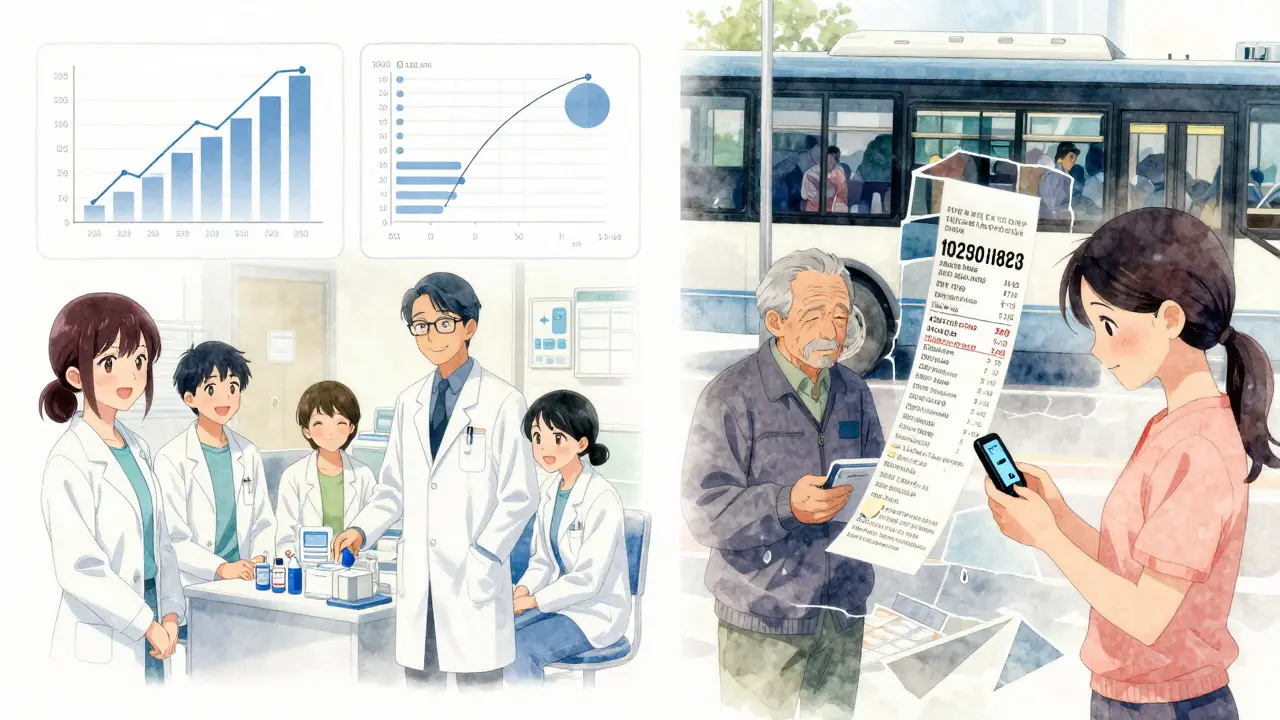
How Regulators Are Changing the Game
The FDA used to treat real-world data as a side note. Now, it’s part of the conversation. Since 2019, the agency has approved 17 drugs using real-world evidence - up from just one in 2015. The 21st Century Cures Act in 2016 opened the door. The EMA in Europe is even further ahead: 42% of post-approval safety studies now use RWE, compared to 28% at the FDA. But regulators aren’t throwing out RCTs. Dr. Robert Califf, former FDA commissioner, said it plainly: "Real-world evidence can complement traditional clinical trial data, but it cannot replace the rigor of randomized controlled trials for initial efficacy determinations." That’s the new balance. Trials still decide if a drug is safe and effective enough to sell. Real-world data decides if it’s worth using in practice - and who it works for.Where Real-World Data Is Making a Difference
Oncology leads the charge. Cancer drugs cost hundreds of thousands of dollars. Placebo trials are often unethical. So companies use real-world data to track survival rates, side effects, and quality of life after approval. Flatiron Health’s database - built from 2.5 million cancer patients across 280 clinics - helped Roche make smarter pricing and development decisions. Rare diseases? RCTs are nearly impossible when only a few hundred patients exist worldwide. Real-world registries fill the gap. Payers like UnitedHealthcare and Cigna now demand RWE before covering expensive new drugs. If a drug doesn’t show value outside the trial, it won’t get paid for. Even clinical trial design is changing. Companies like ObvioHealth now use real-world data to pick better participants. If past records show someone consistently takes meds and shows up to appointments, they’re more likely to stick with a trial. This “prognostic enrichment” can shrink trial sizes by 15-25% - saving time and money.The Big Problems With Real-World Data
Real-world data isn’t magic. It’s full of holes. Data is scattered across 900+ U.S. health systems, each using different software. Records might be incomplete. Some patients disappear from the system. Others are misdiagnosed. A 2019 Nature study found only 39% of RWE studies could be replicated because methods weren’t clear enough. Bias is a huge risk. If a drug is only prescribed to wealthier patients because it’s expensive, real-world data will show it works better - not because it’s superior, but because those patients have better access to care, nutrition, and follow-up. And then there’s the analytics. You need advanced tools to clean, match, and interpret this data. Only 35% of healthcare organizations have dedicated teams for it, according to a 2023 Deloitte survey. That’s why many RWE studies still look shaky.
The Future: RCTs and RWE Working Together
The future isn’t one replacing the other. It’s both working side by side. The FDA’s 2024 draft guidance on hybrid trials is a big step. These trials start like traditional RCTs - controlled, randomized - but then extend into real-world settings after approval. Patients are tracked for years using EHRs and wearables. This gives you the clean start of a trial and the messy truth of real life. AI is helping too. Google Health’s 2023 study showed AI models could predict treatment outcomes from EHR data with 82% accuracy - better than traditional RCT analysis in some cases. That doesn’t mean AI replaces trials. It means it helps us read the noise better. The NIH’s HEAL Initiative, with $1.5 billion in funding, is building RWE networks for pain management - a field where opioids have caused disasters. They’re not just tracking prescriptions. They’re tracking sleep, activity, and mood via apps to see what truly improves quality of life.What This Means for Patients and Doctors
If you’re a patient: don’t assume a drug that worked in a trial will work exactly the same for you. Ask your doctor: "Has this been used by people like me?" If you’re on multiple meds, have other conditions, or are older - your experience might be different. If you’re a doctor: don’t treat trial results as gospel. Look for real-world studies on your patient population. Ask: Who was excluded? How long were they followed? What side effects showed up later? The best decisions come from combining both worlds. A drug approved in a trial gives you confidence. Real-world data tells you how to use it wisely.Final Thought
Clinical trial data tells you what a drug can do. Real-world outcomes tell you what it actually does - for real people, in real life. One isn’t better. They’re both necessary. Ignoring either means you’re seeing only half the picture.Are real-world outcomes less reliable than clinical trial data?
No - they’re just different. Clinical trials are designed to eliminate bias and prove cause-and-effect. Real-world outcomes capture how drugs work in messy, everyday life. Neither is inherently less reliable. The risk comes when real-world data is poorly collected or analyzed. High-quality RWE, with proper statistical methods like propensity scoring, can be just as trustworthy - especially for long-term safety and use in complex patients.
Why do drugs sometimes fail in the real world after succeeding in trials?
Trials use carefully selected patients who are healthier, more compliant, and closely monitored. In real life, patients have other illnesses, skip doses, can’t afford meds, or take other drugs that interact. Real-world outcomes show these hidden challenges. A drug that lowers blood pressure by 20 points in a trial might only drop it by 8 in practice - not because it’s weak, but because life gets in the way.
Can real-world data replace clinical trials?
Not for initial approval. Clinical trials are still the only way to prove a drug works better than a placebo under controlled conditions. That’s required by law. But real-world data is now used to support post-market decisions - like expanding uses, adjusting dosing, or identifying safety risks in vulnerable groups. Think of RCTs as the first test, and RWE as the long-term field report.
How do insurance companies use real-world outcomes?
Payers like UnitedHealthcare and Cigna use real-world data to decide whether to cover expensive new drugs. If the drug only works well in healthy, young patients in trials - but not in older, sicker people who actually need it - payers may restrict access or demand lower prices. Real-world evidence shows if a drug delivers value in practice, not just in theory.
Is real-world data biased against certain groups?
Yes - and that’s a major concern. If data only comes from patients with good insurance, access to specialists, or digital health tools, it misses low-income, rural, or elderly populations. This creates a feedback loop: drugs that work well for the privileged get approved, while others are overlooked. Good RWE studies now actively try to include diverse populations and use statistical tools to correct for these gaps.
What’s the biggest barrier to using real-world data?
Fragmentation. Health data is stuck in hundreds of incompatible systems. Getting clean, usable data from electronic health records, claims, and wearables is hard. Privacy laws like HIPAA and GDPR make sharing harder. Only 35% of healthcare organizations have teams trained to handle this data. Without better infrastructure and standards, real-world evidence will keep being slow and inconsistent.
EMMANUEL EMEKAOGBOR
December 23, 2025 AT 21:29Interesting breakdown. I've seen this in Nigeria - drugs that work perfectly in trials often fail when patients can't afford follow-ups or live miles from clinics. Real-world data isn't messy because it's bad - it's messy because life is messy.
Doctors here treat the person, not the trial profile. That’s why we need both.
Still, the gap in access isn't just about money. It's about trust, language, and whether your doctor even knows the data exists.
CHETAN MANDLECHA
December 25, 2025 AT 05:43Finally someone says this out loud. Trials are for proving a drug works. Real-world data is for proving it works for people like my uncle - diabetic, hypertensive, and works 12-hour shifts. He doesn’t get free meds or weekly check-ins. He gets a script and hope.
siddharth tiwari
December 25, 2025 AT 11:26They're hiding something. Why do trials always exclude the elderly and poor? Coincidence? Or is Big Pharma just testing on the healthy so they can charge the sick more? I've seen the numbers - 80% excluded? That's not science. That's selection bias with a lab coat.
Diana Alime
December 25, 2025 AT 19:19Ugh. I just spent 3 hours reading this and now I’m crying. Why does EVERYTHING have to be so complicated?! I just wanted a pill that works. Why can’t they just make one that works for EVERYONE??
Also I think the FDA is corrupt. My cousin took that drug and her hair fell out. No one told her that. #Rant
Adarsh Dubey
December 26, 2025 AT 17:52The distinction between efficacy and effectiveness is fundamental. Clinical trials answer: Does this drug work under ideal conditions? Real-world data answers: Does it work under real conditions? Both are valid. The error lies in conflating them.
Also, the exclusion criteria in trials aren’t arbitrary - they reduce noise. But the failure is in assuming those results generalize. That’s where RWE becomes essential, not optional.
Bartholomew Henry Allen
December 28, 2025 AT 09:06America leads in medical innovation. Other countries use our trials as gospel. Now we’re letting foreign data and weak real-world studies undermine our standards? This is how we lose our edge. Rigor isn’t elitism - it’s science. Don’t dumb it down for convenience.
Jeffrey Frye
December 30, 2025 AT 08:58Let’s be real - most RWE studies are garbage. They use messy EHRs with missing data, no control groups, and analysts who think correlation = causation. The FDA approving drugs based on this? That’s like using Yelp reviews to design a jet engine.
Also, 39% replicability? That’s not science. That’s guesswork with a fancy name.
bharath vinay
December 31, 2025 AT 01:45They're using RWE to push drugs no one needs. The real goal is profit. Look at the pricing. A drug that works for 45% in the real world still costs $150k a year. Who benefits? Not the patient. Not the doctor. The shareholders. The trials are a smokescreen. The data? Manufactured. The system? Broken.
Usha Sundar
December 31, 2025 AT 08:23My grandma took that drug. Didn’t help. Got dizzy. Couldn’t afford the follow-up. They told her it worked in trials. She said, 'Then the trials weren’t for me.'
She was right.
claire davies
January 1, 2026 AT 12:21As someone who’s worked across three continents in public health, I’ve seen this play out in villages, urban clinics, and refugee camps. Clinical trials are like testing a parachute in a wind tunnel - perfect conditions, controlled variables. Real-world outcomes? That’s jumping out of a plane over the Himalayas with a slightly frayed cord and a prayer.
The beauty of RWE isn’t that it’s clean - it’s that it’s honest. It shows us where our systems fail the people who need help most. And if we’re serious about equity, we have to listen - even when the data is noisy, incomplete, or inconvenient.
Harsh Khandelwal
January 2, 2026 AT 18:19Real-world data? More like real-world propaganda. They cherry-pick clinics that have good records. They ignore the rural ones. They use AI to 'fix' the gaps. It’s not science - it’s PR dressed up as statistics. They want to make you think the system works. It doesn’t. It’s rigged.
Abby Polhill
January 4, 2026 AT 07:52From a data science perspective, the heterogeneity in EHRs is a nightmare. Different ICD codes, inconsistent documentation practices, missing timestamps, and varying levels of granularity across systems. Without standardized ontologies and interoperability protocols, RWE is just noise with a p-value.
And yes - the bias is structural. If your data only comes from urban academic centers, you’re not capturing the real world. You’re capturing the privileged few. That’s not just a limitation - it’s an ethical failure.
Austin LeBlanc
January 6, 2026 AT 03:20You people are naive. You think real-world data is about patients? It’s about control. Once regulators accept RWE, they’ll start cutting funding to trials. Then who pays for innovation? Pharma? No - taxpayers. And then they’ll say, 'Oh, but the drug worked in the real world!' - even when it didn’t. This is how we get dangerous drugs approved. You’re letting the wolves into the sheepfold.
niharika hardikar
January 6, 2026 AT 18:43The methodological rigor of randomized controlled trials remains the cornerstone of evidence-based medicine. Real-world evidence, while supplementary, lacks the internal validity required for causal inference. Its use in regulatory decision-making, particularly for initial approval, represents a dangerous erosion of scientific standards. Without blinding, randomization, and pre-specified endpoints, any observed effect is confounded by selection bias, immortal time bias, and immortal person bias.
Rachel Cericola
January 7, 2026 AT 10:42Let me tell you what I’ve seen in my work with underserved communities. A patient on insulin who can’t afford the test strips? That’s not a trial failure - that’s a system failure. Real-world data doesn’t just show how drugs perform - it shows where our healthcare system breaks down.
And yes, the data is messy. But we have tools now - propensity scoring, machine learning imputation, multi-level modeling - to clean it up without losing the truth. We don’t need perfect data. We need honest data. And we need to stop pretending that a 50-year-old white male in a Boston trial represents everyone.
When we design trials with RWE in mind - recruiting diverse populations, using wearable sensors, tracking adherence through apps - we’re not lowering standards. We’re raising them. We’re making medicine more human.
And if you think that’s risky? Try telling a 70-year-old Black woman with three chronic conditions that her doctor’s 'evidence-based' recommendation was based on a trial that excluded 95% of people like her. That’s the real risk.